
Your Custom Text Here

Free and Easy Budget Printables to Save You Money

Are you looking for an easier way to save money and stay on top of your bills?
You’re not alone.
Many people want to feel more in control of their money, but the budgeting process can feel like too much work.
The great thing is, it doesn’t have to be.
That’s why I’ve created a collection of free and easy budgeting printables—just for you.
Whether you're trying to cut back on spending, pay off debt, or plan ahead for car repairs, these 10 free budget worksheets will help you make better financial decisions.
Get them today! Instant downloads.
- Simple Monthly Budget Planner
- Weekly Spending Tracker
- Budget Binder Cover + Divider Pages
- Bill Payment Checklist
- Debt Payoff Worksheet
- Savings Goals Chart
- Monthly Budget Calendar
- Expense Category Breakdown Worksheet
- Budget Review & Reflection Page
- Annual Budget Summary
- Conclusion
- Learn More / Sources

(1) Simple Monthly Budget PLANNER
Even if this is your first month trying a budget, these tools are made for beginners and busy people alike.
Each printable helps you organize your personal finances, one small step at a time. You’ll be able to track your actual income, manage monthly expenses, and spot spending habits that need a little work. And the best part?
They’re completely free for personal use—no fancy apps, no subscriptions, and no stress.
Just download a printable and grab a pen.
If you’re just starting out with budgeting, this Simple Monthly Budget Planner is one of the best ways to take control of your finances and save money.
It breaks down your actual income and monthly expenses into clear sections, so you can easily see where your money is going.

FREE DOWNLOAD, COURTESY - PATTERSON’S COMMUNITY

Start by writing in how much money you bring in for the month. Next, list your bills, like rent, groceries, car payment, and other regular expenses.
You’ll also track things that change each month, like gas or shopping.
This planner helps you spot spending habits that are costing you more than they should.
At the end of the month, you can compare what you planned to spend with what you actually spent.
That’s how small changes—like eating out less or canceling a service provider you don’t use—can lead to big savings.
This printable is a great foundation template.
Use it every month to make better financial decisions and build toward your long-term financial goals.


(2) Weekly Spending Tracker
The Weekly Spending Tracker is one of the easiest ways to take a closer look at your day-to-day spending—and it can help you save money fast.
Instead of tracking everything once a month, this printable lets you write down each expense as it happens.
From that morning coffee to a last-minute online order, it all adds up.

You can divide your spending into categories like food, gas, personal care, and entertainment.
At the end of the week, total up each category. This will help you spot problem areas and plan better for the following month.
By seeing your daily expenses on paper, you’ll be more aware of your spending habits and more likely to make smart choices.
This tracker is a simple tool, but it plays a big role in helping you improve your personal finances.


(3) Budget Binder Cover + Divider Pages
Sometimes the hardest part of budgeting is keeping everything in one place.
That’s where the Budget Binder Cover and Divider Pages come in.
This printable set helps you stay neat, organized, and motivated—all in one binder.

The binder and cover page give your budgeting system a home, and the divider pages let you split it into helpful sections like:
Monthly Budget
Savings Goals
Debt Payoff
Receipts and Notes
DIVIDER PAGES


Having a place for everything keeps your budgeting process stress-free and helps you stay focused on your financial goals.
When everything is organized, it’s easier to stick with it—and that’s how you save more money month after month.
If you want to see your progress in one spot, this binder setup is for you. Use it for your family budget or just for personal use.
(4) Bill Payment Checklist
Late fees are one of the easiest ways to waste money.
That’s why this Bill Payment Checklist is a must-have.
It helps you keep track of all your regular bills—like rent, utilities, phone, internet, and subscriptions—so you can pay them on time, every time.


The checklist has a simple layout. You write down each bill and check it off once it’s paid.
It’s a great way to see what you need to pay monthly and what’s already taken care of.
Knowing your bills are covered gives you peace of mind and protects your credit score. You’ll avoid late charges, reduce stress, and stay in control of your finances.
💡 Want to Save Time?
All 10 budgeting worksheets on this page are available as free individual downloads. But if you'd prefer to save time and get them all in one neat bundle, you can download the full Budget Binder PDF Pack .
- ✔️ All 10 printable budget worksheets PLUS bonus pages
- ✔️ Binder cover page (Your Choice! Colorful or Printer-Friendly)
- ✔️ Quick-start overview sheet
Everything you need to start budgeting—in one click.
Click here to get the Complete Budget Binder Pack!(5) Debt Payoff Worksheet
Debt can feel overwhelming, but you don’t have to tackle it all at once. This Debt Payoff Worksheet helps you make a clear plan to pay off what you owe, little by little.
And the best part? It can help you save money by avoiding interest and late fees.

With this printable, you’ll list each debt: credit cards, loans, car payments, or medical bills.
Then you’ll write down the balance, due date, interest rate, and minimum payment.
You can also track how much you paid this month and how much is left to go.
Seeing your progress on paper can keep you motivated. It’s a powerful way to build your credit score and improve your financial health.
Whether you’re using the snowball method (smallest debt first) or the avalanche method (highest interest first), this worksheet makes it simple.
(6) Savings Goals Chart
Saving money is easier when you can see your progress.
That’s what makes this Savings Goals Chart so powerful.
It helps you turn your dreams—like a vacation, emergency fund, or car repairs—into specific goals you can reach one dollar at a time.

This printable lets you set your total savings goal and break it into smaller steps.
For example, if you want to save $600, you might divide it into 12 steps of $50 each.
Every time you hit a step, color it in or give it a check mark!
It's a fun way to stay on track.
You can use this chart for short-term goals, like back-to-school shopping, or long-term ones, like building your emergency fund.
It’s great for college students, parents, and anyone who wants to build financial stability.
When you write your goal down and track it, you’re more likely to follow through—and that’s one of the best ways to save more money.
(7) Monthly Budget Calendar
One of the easiest ways to save money is by knowing exactly when money comes in and when bills go out.
This Monthly Budget Calendar helps you see your financial month at a glance so you never miss a payment again.

FREE DOWNLOAD - COURTESY, PATTERSON’S COMMUNITY
This Monthly Budget Calendar helps you see your financial month at a glance so you never miss a payment again.
Use this printable to mark your payday, bill due dates, automatic payments, and other important money events.
You can even use colored pens or stickers to show different types of expenses like rent, groceries, and credit card payments.
This tool is perfect if you’ve ever forgotten to pay a bill or overspent before payday. When you can see your full month laid out, you make better financial decisions and stay in control of your finances.
The calendar is also great for planning ahead.
You’ll know how much money to set aside for big things like holidays, school supplies, or even car repairs.
(8) Expense Category Breakdown WORKSheet
This Expense Category Breakdown Sheet helps you find out where your money is really going—and how to spend smarter.

AN AUTOMATIC DOWNLOAD. COURTESY, PATTERSON’S COMMUNITY
This printable lets you divide your monthly expenses into main categories like housing, food, transportation, health, and fun.
At the end of the month, write how much you planned to spend and how much you actually spent in each area.
By comparing these amounts, you’ll spot the categories where you may be overspending.
Maybe your controllable expenses—like takeout or entertainment—are higher than you thought. That’s where you can cut back and save money without giving up what you need.
This sheet is a great way to get honest with yourself about your spending habits. Use it every month to make sure your total budget stays on track.
(9) Budget Review & Reflection Page
Saving money isn’t just about tracking numbers—it’s also about learning from them.
This Budget Review & Reflection Page gives you a chance to stop, think, and plan for the following month.

AVAILABLE AS A FREE AUTOMATIC DOWNLOAD
At the end of each month, use this printable to answer a few simple questions:
What went well?
Where did I overspend?
What did I learn about my spending habits?
What can I do better next month?
You’ll also review your actual income, total expenses, and any money saved.
Taking time to reflect helps you understand your spending habits and make stronger financial decisions in the future.
This page works well with any budgeting method and is a great way to build financial stability over time.
Even a little bit of reflection can go a long way. Use it to set specific goals and stay focused.
(10) Annual Budget Summary
Want to see the big picture?
The Annual Budget Summary helps you track your money month by month, so you can find patterns, set new goals, and save more in the future.

This printable lets you record your actual income, monthly expenses, total savings, and key wins for each month of the year.
It’s a great tool for understanding how your personal finances change over time—and how small improvements can add up to big results.
Use this sheet to plan for major changes, like home repairs, family vacations, or even investing.
By reviewing your total budget for the year, you’ll be able to make stronger financial decisions and set smart investment objectives.
The more you know about your past money habits, the better prepared you’ll be to grow your savings and reach your long-term financial goals.
And that means real financial stability—one month at a time.

Stress-Free Organization
Colorful or Printer-Friendly
Helps You Focus
Budgeting Saves Money!
CONCLUSION
Managing your money doesn’t have to be hard. When you have the right tools, you can take control of your finances, make smart choices, and save money.
In this article, you discovered 10 free and easy budgeting printables worksheets to help you track spending, pay off debt, plan savings, and stay on top of your bills.
Whether you’re building a family budget, living on a tight income, or just want to improve your financial health, there’s a printable here for you.
Start simple. Pick one or two printables to try this week.
Add more as you go. The great thing is, these tools are flexible, free, and made for real life.
Each small step you take brings you closer to your financial goals.

9 Estate Planning Basics for Protecting Family Wealth

Why Estate Planning Matters
Sometimes, people pass away without leaving clear instructions about who should get their money or property.
That can make things very confusing and stressful for their loved ones. That’s why estate planning is so important.
Estate planning means writing down what you want to happen with your belongings after you die, or if you get very sick.
It helps your family members know what to do, so they don’t have to guess or go to court to figure things out (Source: LegalZoom).
In this article, you’ll learn 9 simple steps to create a plan that fits your life.
This information is for education and practical steps only. For advice specific to your situation, please consult a legal or financial professional in your area.
- Create a Last Will and Testament
- Powers of Attorney and Healthcare Directives
- Designate Beneficiaries
- Set Up a Trust
- Minor Children and Special Needs
- Update Your Plan After Major Life Events
- Establish a Durable Power of Attorney
- Plan for Estate and Inheritance Taxes
- Review and Organize Your Documents
- Conclusion
- Learn More / Sources

(1) Create a Last Will and Testament
The first step in estate planning is making a last will and testament.
This is a legal document that tells people what you want to happen with your things after you die.
It can help your family know how to divide your financial assets, like your bank account, house, or car (Source: LegalZoom).

If you have minor children, your will is even more important.
It lets you choose a guardian—someone who will take care of your children if something happens to you. Without a will, the court might choose someone you wouldn’t want (Source: Nolo).
Having a will can keep your family from having to go through long, stressful court cases, known as probate court.
Even though some things may still go through court, having a will can make everything faster and easier for your loved ones.

It’s a good idea to update your will if there are major life events, like a new baby, a divorce, or someone you named in your will passes away (Source: American Bar Association).
You can write a simple will with help from a lawyer or an online service, but it’s always best to have a professional check it to make sure it follows your state laws.
TIP: A comprehensive kit simplifies the process by giving you all the necessary documents you need in one package.

Making a will is a crucial aspect of financial management and a simple way to give your family peace of mind.
It shows that you care enough to plan ahead and protect the people you love.
(2) Powers of Attorney and Healthcare Directives
What if something happened to you and you couldn’t speak or make decisions for yourself? Who would pay your bills, talk to your doctor, or make sure your wishes were followed?
That’s why it’s important to have two key legal documents in your estate planning toolkit: a power of attorney and a healthcare directive.
POWER OF ATTORNEY
A power of attorney lets you choose someone to handle your financial matters if you can’t.
This could mean paying your rent, managing your bank account, or handling your life insurance policies.
The person you pick should be someone you trust to make smart financial decisions for you (Source: Nolo).
DURABLE POWER OF ATTORNEY
There’s a special kind called a durable power of attorney.
This means it stays in effect even if you become very sick or unable to communicate. It helps your family avoid delays or court problems if something unexpected happens (Source: LegalZoom).
HEALTHCARE DIRECTIVE
The second document you need is a healthcare directive, sometimes called a health care proxy or medical power of attorney.

This form lets you choose someone to make medical treatment decisions for you if you can’t speak for yourself.
It also lets you write down what kind of care you want.
For example, if you want machines to keep you alive or if you prefer end-of-life care at home.
These two documents help your loved ones feel confident that they’re doing what you would want.
It gives everyone peace of mind during tough times and keeps your financial affairs and healthcare decisions in the hands of people you trust. (Source: Mayo Clinic)
It’s a good idea to talk with your doctor, lawyer, or a financial advisor when creating these forms.
Every state has different rules, so it’s smart to make sure your papers follow the right state laws (Source: American Bar Association).


(3) DESIGNATE Beneficiaries
One of the best ways to make sure your money goes to the right people is by choosing a beneficiary.
A beneficiary is the person who will receive your money from certain accounts after you pass away.

When you open these accounts, you’re usually asked to fill out a beneficiary designation form.
This form tells the company who should get the money in the event of your death.
Even if your last will says one thing, the beneficiary form on the account wins.
That’s why it’s so important to check and update your beneficiary forms, especially after major life events like a divorce, marriage, or birth of a child (Source: Investopedia).
COMMON MISTAKE
A common mistake people make is forgetting to update these forms:
Your old form names someone you no longer want to receive the money, like an ex-spouse.
If that happens, it could cause problems for your family members and lead to unintended consequences.
Here’s a tip: Check your beneficiary forms once a year or whenever something big changes in your life.
This simple step helps make sure your financial assets go exactly where you want them to.
SECONDARY BENEFICIARY
You can also name a secondary beneficiary—this is someone who will receive the money if your first choice passes away before you do.
It’s one more way to create a secure future for your loved ones.
If you’re not sure who to choose or how it affects your financial situation, talk to a financial advisor or estate planner. They can help you make the right choice for your specific situation.


(4) SET UP A TRUST
A trust is a helpful tool in estate planning that lets you protect and manage your money, house, or other financial assets—both while you’re alive and after you pass away.
It can also help you avoid the long and sometimes costly process of probate court (Source: LegalZoom).
Here’s a clear and simple summary of the four main types of trusts:

Trusts are grouped in two main ways:
Living Trust vs. Testamentary Trust
A living trust, also known as an inter vivos trust, is created while the person (or grantor) is still alive.
Whereas a testamentary trust is created after the grantor dies, based on instructions in their will.
Revocable Trust vs. Irrevocable Trust
A revocable trust can be changed or canceled while the grantor is alive. An irrevocable trust cannot be changed or canceled once it is created.
These categories help determine when the trust is created and how much control the grantor has over it.

A trust works like this
You (the person creating the trust) put things like your home, money, or life insurance policies into the trust.
Then you name someone to manage it—called a trustee.
You also list who will get those things after you pass away. These people are called beneficiaries.
Many people also set up something called a family trust, which helps make sure your financial matters are handled smoothly and privately.
Unlike a will, a trust doesn’t have to go through court, which means your family can get what you’ve left them faster.
Trusts CAN BE A POWERFUL TOOL
Trusts are a smart choice for families who need extra protection and planning.
They can help avoid court delays if you own property in multiple states, provide support for minor children or loved ones with special needs, reduce inheritance taxes, and prevent money from being spent too quickly.
Unlike a basic will, a trust offers more control and flexibility over how your assets are managed.
A trust can be a powerful tool for building financial security and making sure your wishes are followed for future generations.
It’s smart to work with a financial planner or estate planner who understands your specific situation and the current laws in your state.
(5) MINOR CHILDREN AND SPECIAL NEEDS
When creating your estate plan, it’s important to include clear steps to protect minor children and loved ones with special needs.
This kind of careful planning ensures your family members are supported, even if you're no longer here to care for them.
Naming a Guardian for Minor Children
If you have underage children, your last will should include a legal document that names a guardian.

Without this, a court will decide who takes care of your children. But if you name someone in your will, the court will usually respect your wishes (Source: Nolo).
This gives you the power to choose someone who shares your values, has the ability to provide a safe home, and will offer love and stability.
It also gives your children peace of mind, knowing they’ll be cared for by someone they know and trust.
Using a Special Needs Trust to Protect Benefits
For a loved one with special needs, leaving money to them directly can create problems.

It could affect their eligibility for important programs like Social Security or Medicaid. That’s why many families use a special needs trust.
A special needs trust allows your loved one to receive support for things like medical treatment, transportation, or education—without losing access to government benefits (Source: Investopedia).
You’ll also name a trustee, someone you trust to manage the money and make sure it's used the right way.
Tailoring the Plan to Fit Your Family
Whether you’re planning for minor children or someone with unique needs, these steps are a necessary aspect of financial management.
It’s a smart way to make sure your family’s future is secure and that their needs are met in the way you intended.
If you’re not sure where to begin, it’s a good idea to meet with a financial advisor, estate planner, or legal professional who understands your specific situation and your state’s current laws (Source: American Bar Association).
(6) UPDATE YOUR PLAN AFTER MAJOR LIFE EVENTS
Why Estate Plans Need Regular Updates
Life changes—and so should your plan. That’s why it’s important to update your legal documents when things in your life shift.
Creating a proper estate plan is not a one-time task.
Keeping your plan current helps protect your financial assets, avoid unintended consequences, and ensure your wishes are followed.
What Counts as a Major Life Event?
Certain changes in your life should prompt a review of your estate planning documents.

Each of these events can impact how your financial affairs are handled or who should be in charge of your legal decisions.
Without updates, your estate plan might no longer reflect your true wishes, which could lead to delays or mistakes in court (Source: LegalZoom).
What Could Go Wrong Without Updates?
If your last will still names an ex-spouse or someone who has passed away, your distribution of assets could go to the wrong person.
Or if you move to a new state, your plan might not follow that state’s current laws, causing delays and complications (Source: Investopedia).

PHOTO CREDIT: WEALTH. COM — A COMPREHENSIVE GUIDE
Make Estate Plan Reviews a Yearly Habit
It’s a good idea to review your estate plan once a year, just like an annual health checkup.
You don’t need to make changes every time, but reviewing your plan helps you catch anything that’s out of date.
This small habit plays a crucial role in financial management and gives you and your family peace of mind.
Don't Forget Beneficiary Designations
Beneficiary forms are just as important as your will.
Make sure your retirement plans, life insurance policies, and bank accounts have the correct beneficiary designations.
These designations are separate from your will and will override anything in it, so keeping them updated is key (Source: Trust and Will).
When in Doubt, Ask for Help
If you’re not sure whether a change in your life should lead to an update, talk to a financial planner, estate planner, or tax advisor.
They can guide you based on your specific situation and make sure your estate plan follows your state’s current laws.
(7) Establish a Durable Power of Attorney
Imagine you’re in the hospital and can’t talk or sign papers.
Who will pay your bills, manage your bank account, or handle your financial matters?
That’s where a durable power of attorney comes in.
This important legal document allows you to name someone you trust—called an “agent”—to take care of your money, property, and daily responsibilities if you can’t do them yourself (Source: Nolo).

What Makes It “Durable”?
The word “durable” means the power continues even if you become very ill or are injured.
Without this document, your family members might have to go to court to take control of your financial affairs—a stressful and time-consuming process.
Having a durable power of attorney in place is a crucial aspect of financial management and part of any comprehensive estate plan.
This person plays a vital role in your financial planning, so choose someone who is trustworthy, organized, and understands your financial goals and wishes.
Your agent can even file your taxes, among other duties.

Choosing the Right Agent (and a Backup)
Many people pick a spouse, adult child, or close friend to serve as their agent.
It’s also a good idea to name a backup agent in case your first choice is unavailable. Having this extra layer ensures your plan stays on track, even if something unexpected happens.
Make It Official and Accessible
Because state laws vary, it's wise to work with a financial advisor, estate planner, or lawyer to make sure your form is legal and complete.
Once your document is ready, keep it in a safe place and give a copy to your agent.
This small act of careful planning can save your loved ones stress and provide you both with lasting peace of mind.
(8) Plan for Estate and Inheritance Taxes
Many people don’t realize that when they pass away, their financial assets might be taxed before their family can receive them.
That’s why it’s important to plan ahead for estate taxes and inheritance taxes—especially if you have a lot of money or own real estate.
Let’s break it down:

An estate tax is a tax on everything you own when you die. This includes your home, savings, cars, and even life insurance policies if they’re part of your estate.
In the United States, the federal government only charges this tax if your estate is worth over a certain amount, currently over $13 million per person as of 2024 (Source: IRS).
An inheritance tax is different. It’s a tax that some states charge the person who receives the money or property. Not all states have this tax, so it depends on where you live and where your property is located (Source: Investopedia).
Planning ahead can help lower or even avoid these taxes. Here are a few smart ideas:
You can set up trusts, such as an irrevocable trust or an irrevocable life insurance trust (ILIT), to move assets out of your name and potentially reduce estate taxes.
You can also give gifts within the yearly gift tax limit, name beneficiaries for your retirement accounts, bank accounts, and life insurance policies, and use charitable trusts to support causes you care about while reducing taxes.
You don’t have to figure this out on your own.
It’s a good idea to meet with a tax advisor or financial planner who understands your specific situation, especially if you have a large estate or own property in more than one state.
Making a plan now can help your family avoid surprise tax bills and protect the distribution of your assets for future generations. That’s a smart way to bring financial security and peace of mind to the people you care about most.
(9) Review and Organize Your Documents
Once you’ve created your will, set up trusts, picked your beneficiaries, and written out your wishes, there’s still one more important step—reviewing and organizing all of your estate planning documents.
First, check that everything is complete and up to date.
Look over your documents to make sure names, dates, and instructions are correct.
If your financial situation has changed, or if there’s been a major life event, it may be time to make updates.
Next, organize your documents in a safe but easy-to-find place. Use a folder or binder to keep your will, trusts, retirement account info, and healthcare documents together.
You can even label each section to make things clear. Make sure someone you trust knows where to find them, like your personal representative or a close family member.
Doing this helps prevent confusion, delays, and legal trouble. It’s a smart way to keep your plan clear, complete, and ready.
It’s brings peace of mind to you and your loved ones.
(10) CONCLUSION
Start Small—Plan Big
Planning for the future might feel like a big job, but taking small steps now can make a big difference later.
With the right estate planning tools, you can make sure your family members are protected, your wishes are followed, and your hard-earned financial assets go to the right people.
Reviewing the 9 estate planning basics helps ensure your plan is complete, up to date, and tailored to your needs.

Why These Steps Matter
Each of these steps plays a crucial role in financial management.
They help avoid unintended consequences, give you and your loved ones peace of mind, and ensure your wishes are clearly understood.
Estate planning isn’t just for the wealthy—it’s for anyone who wants to protect their home, family, and financial matters in a smart and loving way (Source: LegalZoom).
Your Next Step
Start by gathering your important papers, thinking about who you trust, and writing down your wishes.
Then, talk with a financial advisor, estate planner, or legal expert who can help you turn those ideas into a real plan that meets your specific situation.
Remember, estate planning is not a one-time task—it’s an ongoing process. Review it often and make changes when needed.
That’s how you build a secure, lasting legacy for your future generations.
(11) LEARN MORE / SOURCES
“Estate Planning Information & FAQs.” American Bar Association.
“What Is a Beneficiary? Role, Types, and Examples.” Investopedia, Investopedia, 20 Nov. 2003.
“Understanding a Special Needs Trust and Its Benefits.” Investopedia, Investopedia, 26 Apr. 2011.
Albee, Carolyn. “What Is Estate Planning? Everything You Need to Know.” LegalZoom, 29 July 2024.
“Living Wills and Advance Directives for Medical Decisions - Mayo Clinic.” Mayo Clinic.
“Popular Methods to Avoid Probate.” www.Nolo.Com, Nolo, 10 Oct. 2011.
“How to Appoint a Guardian for Your Children.” www.Nolo.Com, Nolo, 10 Oct. 2011.

How to Build a Family Emergency Fund on Any Budget

Life can be unpredictable.
One moment, everything seems fine, and then suddenly, your car breaks down, or someone in your family needs a visit to the hospital.
These unexpected expenses, like car repairs, medical bills, or even home repairs, can quickly throw your budget off track.
That’s why it’s so important to have an emergency fund.
Even if you feel you don’t have much money, you can still build an emergency fund that gives peace of mind for your family.
The good news? You can do this on any budget by taking it one step at a time!
- What Is an Emergency Fund?
- How Much Should You Save?
- The Right Account for Your Emergency Fund
- Creating a Monthly Budget and Tracking Expenses
- Setting Up Automatic Transfers
- Finding Extra Cash for Your Emergency Fund
- Prioritizing Your Emergency Fund Goals
- Avoiding Emergency Fund Common Mistakes
- Planning for Specific Types of Emergencies
- Growing Your Emergency Fund
- Conclusion
- Recommended Resources
- Research Sources / Related Articles

(1) What Is an Emergency Fund?
An emergency fund is a stash of money you set aside to cover unexpected expenses.
It is designed to help you cover expenses such as medical emergencies, car repairs, or natural disasters without undue stress or the need to use credit cards.
Think of it as your financial cushion or safety net.
How much should you set aside?

The recommended amount is 3-6 months’ of expenses.
But if that sounds overwhelming, don’t worry!
You can start small and build up over time. The most important thing is to get started.
An emergency fund isn’t meant for planned expenses like vacations or new gadgets.
It’s for unforeseen circumstances that really catch you off guard.
Keeping a small amount of emergency cash at home can be a smart backup plan, especially during power outages or natural disasters.
TIP: A fireproof, waterproof cash bag can help you protect that money from unexpected damage, keeping it safe and ready when you need it most
(2) How Much Should You Save?
The first step to building an emergency fund is to figure out how much you need to save.
This depends on your monthly expenses.
Think about things like mortgage payments, rent, car payments, utilities, groceries, and transportation.
Add up these essential expenses to find out your monthly expenses.
Experts suggest having three to six months’ worth of expenses saved up.
For example, if your monthly expenses are $2,000, your goal might be to save $6,000 to $12,000.
But if that feels like too much, start by setting smaller goals like saving just one month’s expenses first. This makes the goal less scary and more manageable.
Break your goal into smaller amounts to stay motivated. For example, aim to save $500 first, then increase your goal to $1,000, and keep going.
Saving is challenging. But breaking it into smaller steps makes it easier.
TIP: Using a Clever Fox Budget Planner is a great way to stay motivated.
You can watch your progress as you move closer to your savings goals, one small amount at a time.
(3) The Right Account for Your Emergency Fund
When it comes to choosing the right type of account, you want something that’s safe, earns a little interest, and is easily accessible when needed. Consider these options:
Savings Account
A basic savings account is a good choice because it’s safe and offers easy access to your funds.
It’s a great place to keep your emergency money separate from your checking account so you’re not tempted to spend it.
Most savings accounts at banks and credit unions are insured, which means your money is protected up to certain limits if the bank has problems.

Money Market Account
This is another good option. It usually offers higher interest rates but still allows you to withdraw money when needed.
Money market accounts often come with a debit card or checks, making it easy to access your savings quickly in an emergency.
Some banks may require a higher starting deposit for a money market account, but you’ll often earn more interest over time.
Credit Union Accounts
Credit unions often have lower monthly fees and better interest rates than traditional banks.
They are member-owned, which means they usually focus more on helping their members save money rather than making big profits.
Opening an account at a credit union can be a smart move if you want personal service and better savings options.

Whichever account you choose, avoid using accounts that charge high fees or make it hard to withdraw your money in a hurry.
(4) Creating a Monthly Budget and Tracking Expenses
If you’re wondering how to save extra money, creating a monthly budget is one of the easiest ways to start.
A budget helps you see where your money is going each month.

It’s a simple and easy-to-use tool designed to help you track your income, expenses, and savings goals.
This free 2-page budget tracker has plenty of space to fill in your numbers.
It’s a great way to stay organized, focused, and in control of your financial future.
A monthly budget gives you a clear picture of where your money is going each month and helps you find extra cash to grow your emergency fund.
This way, you can spot unnecessary expenses like extra subscriptions or unused gym memberships.
You can use a checking account to track what you’re spending on things like groceries, utilities, and entertainment.
Look at your expenses and ask yourself, “Is there something here I could cut back on?”
Review your budget regularly to make sure it reflects your current financial situation. This will help you stay on track with your savings goals.
(5) Setting Up Automatic Transfers
One of the best ways to build an emergency fund is by setting up automatic transfers from your checking account to your emergency fund account.
Automatic transfers take the pressure off remembering to save because it happens without you even thinking about it.
Even small transfers, $10 or $20 a week, can grow into a strong safety net over time.
This simple habit makes saving a priority and helps you stay on track with your financial goals, no matter how busy life gets.
This way, you won’t forget to save, and you won’t be tempted to spend the money elsewhere.
Most financial institutions allow you to set up direct deposit from your paycheck or transfer a portion of your paycheck each month.

This is an easy way to develop a strong savings habit and reach your goals faster.
Even if you can only transfer $25 a month, it’s still progress!
TIP: If you prefer a physical budgeting tool alongside digital automatic transfers, try the Cash Envelope Wallet . It will give you a visual cash flow system.
(6) Finding Extra Cash for Your Emergency Fund
If saving money seems tough, check out these creative ways to find extra cash.
Tax Refunds
If you get a tax refund each year, use it to give your emergency fund a boost.
Even putting half of your refund into savings can move you closer to your emergency fund goal faster.
Think of your refund as a special chance to protect your future, not just a bonus for spending.
Cash Gifts
Consider putting any birthday or holiday money directly into your savings account.
It might be tempting to spend it right away, but using it to build your emergency savings will give you longer-lasting benefits.
Every gift you save is another step toward creating a strong financial safety net for your family.
Side Hustles
Doing a side hustle like freelance work, babysitting, or dog walking can be a great way to earn some extra money.
You can even start small by doing something you already enjoy, like selling crafts, tutoring, or helping neighbors with errands.

BOOST YOUR INCOME
TIP: If you're looking for simple ways to earn extra money, a great place to start is the book Side Hustle: From Idea to Income in 27 Days.
It offers easy-to-follow ideas to boost your income so you can add more to your emergency savings faster.
Even cutting back on unnecessary expenses like eating out less often or using public transportation can help you save.
(7) Prioritizing Your EMERGENCY FUND Goals
It’s essential to balance your financial goals while saving for emergencies.
If you have credit card debt, loans, or other payments, it’s okay to work on them alongside your emergency savings.
Just make sure you’re putting something away for emergencies, too.
Focus on building your emergency fund before putting extra money into a retirement account or investments.
Remember, an emergency fund helps you deal with unplanned expenses without going into more debt.

Crushing debt is just as important as building your emergency fund because it frees up more of your money for future savings.
Paying down debt quickly means you’ll have fewer monthly bills, less stress, and a stronger foundation to reach your financial goals.
For example, when you’re paying off credit card debt and trying to save for emergencies, you might decide to split extra money — half toward your emergency fund and half toward your debt.
This way, you’re moving forward on both goals without leaving yourself unprotected.
Reaching your savings goal might take time, but stay consistent and remember you’re working toward a stronger financial future.
(8) Avoiding Emergency Fund Common Mistakes
When building an emergency fund, it’s essential to avoid some common mistakes.
Relying on Credit Cards
Credit cards can lead to high-interest debt if you use them for emergency expenses.
When you depend on credit cards, you might end up paying much more over time because of extra interest charges.
Building an emergency fund means you can cover sudden costs without adding to your debt and stressing about big monthly payments later.

Withdrawing Too Often
Only use your fund for real emergencies. Keep it separate from your everyday accounts.
If you dip into your emergency savings for non-urgent things, it may not be there when you truly need it.
Keeping your fund in a separate savings account makes it harder to spend by accident and helps you stay focused on your bigger goals.
Not Saving Enough
Aim for at least three months of expenses as a starting point.
If you can eventually build up to six months of expenses, you'll have even greater protection against unexpected events like job loss or big medical bills.
Saving slowly but steadily will give you peace of mind, knowing you’re ready for whatever life brings.
By avoiding these mistakes, you can build a cash reserve that’s ready for whatever life throws your way.
(9) Planning for Specific Types of Emergencies
Different emergencies need different plans. Here’s how to handle a few specific situations:
Medical Emergencies
Keep your emergency fund ready for sudden medical expenses not covered by insurance.
Even with good insurance, you might have to pay for things like co-pays, prescriptions, or unexpected treatments.
Having cash set aside means you can focus on getting better instead of worrying about how to pay the bills.


Car Repairs
If you rely on your car for work or family needs, it’s smart to have a portion of your fund dedicated to car maintenance or unexpected breakdowns.
Car repairs can happen suddenly and be very expensive, especially for major problems like transmission issues.
Saving ahead of time helps you avoid using credit cards or loans just to keep your car running.
TIP: Sometimes, having the right tools on hand can save you from sudden expenses. A Roadside Emergency Car Kit is a smart investment to handle car troubles without paying for expensive tows or repairs right away.
Job Loss
Losing a job can happen without warning, even if you’re a good worker.
Having a few months’ worth of expenses saved in your emergency fund gives you time to find new work without rushing or panicking.
Home Repairs
Things like broken appliances, leaky roofs, or plumbing problems can be costly.
Even small home repairs can add up quickly if they aren't fixed right away.
Planning for these unforeseen circumstances in your emergency fund gives you peace of mind and protects your home’s value.


Natural Disasters
Storms, floods, and other natural disasters can cause damage to your home, car, or belongings.
These unexpected events can be expensive to recover from, especially if insurance doesn’t cover everything right away.
An emergency fund can help you cover costs like temporary housing, repairs, or replacing essentials if disaster strikes.
Having extra money set aside means you won’t have to rely on credit cards or loans when you’re already dealing with the stress of a natural disaster or other emergencies.
An emergency fund gives you the power to take care of your family’s immediate needs, like food, shelter, and safety, without worrying about where the money will come from.
(10) Growing Your Emergency Fund
Congratulations! You’re well on your way.
If you’ve studied the previous sections, you know why having an emergency fund is so important, even if you’re starting with a small amount.
Now your job is to maintain these savings and grow them over time.
Review Your Fund Regularly
Make sure your fund reflects your current expenses and financial situation.
It’s a good idea to check your savings at least twice a year or whenever big changes happen, like a new baby or a move.
If your monthly expenses grow, you may need to adjust your emergency fund goal to stay fully protected.
Look for Higher Interest Rates
Once you have enough saved, consider moving a portion of your fund to a money market account or another account with higher interest rates.
Higher rates can help your money grow faster without you doing any extra work.
Just make sure the account still allows easy access to your money in case of a real emergency.
Stay Consistent
Keep up your savings habit by making regular contributions, even if it’s just a little at a time.
Saving small amounts on a regular basis builds a strong habit that gets easier over time.
Remember, even a few dollars every week can make a big difference when you stick with it.
As your income grows or your expenses change, adjust your fund to make sure it’s enough for your family’s needs.
CONCLUSION
Take Action to Secure Your Family’s Financial Future
By taking it one step at a time, starting with small amounts, and being consistent, you can create a financial safety net that will protect your family during unplanned expenses.
This fund offers you peace of mind and helps keep your family financially secure in the face of financial emergencies.
The best way to get started is to take action today.
Review your budget, set up an account, and start saving.
Recommended Resources
Need help building your emergency fund faster? Looking for tools to make saving easier?
Here are some great resources you might find helpful:
The Total Money Makeover by Dave Ramsey – Learn how to take control of your money and create a financial safety net.
Clever Fox Budget Planner – A planner designed to help you track monthly expenses and grow your savings habit.
Budget Sheets – Visualize your savings goals with easy-to-use templates.
Roadside Emergency Car Kit – Be ready for unexpected car repairs and avoid expensive emergencies.
Side Hustle: From Idea to Income in 27 Days – Discover simple ways to earn extra money and boost your emergency fund.
Taking small steps today can make a big difference tomorrow!
RESEARCH SOURCES

Teaching Financial Goals Across All Generations

Many people wish they had a better understanding of personal finances when they were younger.
The truth is, people of all ages—from younger children to baby boomers—can benefit from strong financial education.
Whether it’s setting financial goals, building savings, or avoiding debt, each generation faces different challenges when it comes to money.
In this article, we’ll discuss ways to teach money skills across different generations.
You’ll learn how to help your family—especially younger generations—create strong habits, avoid unnecessary debt, and work toward a brighter financial future.

(1) Financial Goals - what are they?
Start with the basics.
Before you can teach others about money, you need to understand one key concept—financial goals.
Simply put, a financial goal is what you plan to do with your money.
The goal can be large or small.
It might be saving for a new car, paying off credit cards, building an emergency fund, or preparing for retirement savings.
Goals give your money a clear purpose.

When families pass down financial knowledge and work together, all family members have a better chance at reaching their financial goals and building long-term stability.
There can be short-term goals, like saving for a birthday gift or a small trip.
There can also be long-term goals, like buying a home, investing in the stock market, or planning for retirement.
No matter your age, setting goals helps you stay on track and make better financial decisions.
If you don’t set goals, your money might get spent on things that don’t matter.
Talking about financial goals within your family helps everyone—younger generations, older generations, and everyone in between—build a secure financial future.

It’s a great way to teach the value of money and why planning ahead is such an important concept.
According to Schwab’s 2023 Modern Wealth Survey, people who have a written financial plan are more likely to feel financially stable and confident about their future (Source: Charles Schwab).
Right now, 64% of Americans are living paycheck to paycheck, including 48% of people who earn more than $100,000 a year (Source: CNBC).
That shows us how important it is to talk about money—early and often.
(2) Teach Age-Appropriate Money Basics
Teaching money skills works best when the lessons match the person’s age.
What works for a 10-year-old won’t work the same way for someone in their 40s.
But no matter the age group, everyone can learn smart money habits.

TEACHING YOUNGER CHILDREN THE VALUE OF MONEY
Start with younger children by teaching them the value of money using chores or a weekly allowance.
Show them how to save a small amount in a jar or piggy bank.
Take them to the grocery store and let them help compare prices. This teaches them how to spend wisely.

FOR TEENS AND HIGH SCHOOL STUDENTS, USE REAL-LIFE EXAMPLES TO ILLUSTRATE CONCEPTS.
If teens have part-time jobs, help them open a bank account or use a debit card.
Explain how saving for a goal feels better than spending money just to fit in on social media.

When it comes to young adults or Gen Zers, focus on bigger lessons—like how to manage credit cards, avoid unnecessary debt, and pay down student loans.
Show them how to build a strong credit score and why a savings account or emergency fund is so important.

Adults —Gen Xers and Baby Boomers—should learn how financial planning, estate planning, and wealth management can protect their family’s future.
They can also pass along financial lessons to their children and grandchildren.
Even older generations can play a powerful role. They can help the next generations avoid mistakes by sharing stories and experiences about their own financial decisions.
According to a 2022 T. Rowe Price survey, 37% of parents avoid money conversations with their children, despite the importance of financial education (Source: T. Rowe Price, page 79).
(3) HAVE REGULAR Family Meetings
Family meetings are a great way to build financial knowledge together
One of the best ways to teach financial goals at home is by holding regular family meetings.
These don’t have to be long or boring. In fact, they can be fun and helpful for everyone, no matter how young or old.
You can start by setting aside one night each month to talk about money management or your family budget.
Choose a quiet time, like after dinner. Let each person share their financial goals, whether it’s saving for a toy, paying off credit cards, or building a bigger retirement fund.
Also, use this time to teach basic ideas like how to handle unexpected expenses or how to create a simple budget.
If you have younger family members, keep it simple and ask them fun questions like, “What would you do with $100?”
Encourage older family members to share real-life stories, such as how they saved for a house or handled job loss.

These talks help the next generation understand that money isn’t just about spending—it’s about making smart financial decisions that lead to a secure financial future.
The more your family talks about money, the stronger your overall financial knowledge will be.
Research from the University of Cambridge found that children's money habits are formed by age 7 (Source: Money Advice Service)—so it’s never too early to start these conversations.
(4) Make Learning Fun and Easy
Learning about money doesn’t have to feel boring or confusing. In fact, the right tools can make teaching financial concepts fun, easy, and something your whole family can enjoy.
For younger children, try using apps, printable games, or free YouTube videos that teach them about money, setting goals, or tracking small savings.
You can also give them play money to practice making decisions. This helps them understand the value of money in everyday life.
For teens and young people, technology can be a great teacher.
Many financial services companies offer budgeting apps or teen-friendly debit cards that let you monitor spending together.
These tools teach financial responsibility and show how small purchases add up.
Adults may benefit from spreadsheets, online courses, or working with a financial advisor.
These tools are helpful for wealth management, estate planning, or learning about mutual funds and the stock market.
If you’re planning for retirement, ask a registered investment adviser for investment advice that fits your family’s long-term needs.
No matter your age, there’s a powerful tool out there that can help you learn, grow, and take control of your personal finances.
The key is to start small, stay curious, and pick tools that match your life stage and money goals.
A 2023 FINRA study showed that only 34% of Americans could correctly answer four out of five basic financial literacy questions (Source: FINRA).
(5) Avoiding Common Money Mistakes
When it comes to money, it’s easy to make mistakes—especially if no one ever taught you how to handle it.
But the good news is this: you can avoid many problems by learning what to look out for and teaching others to do the same.
One of the biggest mistakes people make is relying too much on credit cards without a plan to pay them off. This often leads to unnecessary debt.
Talk with your family—especially younger generations—about using credit the smart way. Explain that credit is a tool, not free money.
Another mistake is skipping out on an emergency fund. Life can bring unexpected expenses, like car repairs or medical bills.

If you don’t have money set aside, you might end up using credit and falling deeper into debt.
Many families also forget to compare interest rates when opening a bank account or borrowing money.
Even a small difference in rates can cost you a lot of money over time. Learning and teaching how to compare rates is a simple but important concept in family financial planning.
And here’s one more: not asking for help.
A financial advisor or legal advisor can guide your family through big money decisions like estate planning, choosing insurance products, or making smart investment decisions.
By talking about these money mistakes openly and early, you help your family build financial knowledge, stay out of trouble, and move toward a more financially secure future.
The average U.S. household carries $6,501 in credit card debt, and 43% of adults don’t have enough savings to cover a $1,000 emergency (Source: Bankrate).
(6) Planning for the Future
Saving and Investing
One of the smartest things you can teach your family is how to save and invest. Both are important, but they work in different ways—and knowing the difference can lead to long-term financial success.
You can use a savings account for short-term goals or in case of an emergency. Everyone in the family—from kids to grandparents—should have money saved for surprises.

When you invest in things like mutual funds or the stock market, you take more risk—but you also have a chance to earn more.
This is where understanding compound interest becomes a powerful tool.
Here’s how it works: if you put money into an account that earns interest, and you leave it alone, you’ll start earning interest not just on your original amount—but also on the interest it earned before.
Over time, this snowballs.
For example, if you start with just $1,000 and add $100 a month into an account that earns 6% a year, in 30 years, you’ll have over $100,000.
That’s the power of starting early and being consistent.
Talk to a registered investment adviser or financial advisor to help your family understand what’s best for them.
Whether it’s building retirement accounts, planning for college, or reaching other long-term goals, learning about investing is a key step toward financial independence.
People who begin investing in their 20s can end up with twice as much money at retirement compared to those who wait until their 30s (Source: Fidelity).
(7) How to Teach the Next Generation
Teaching financial skills shouldn’t stop with just one person.
If you want your family to build long-lasting wealth and make smart choices, you have to pass down what you know. This is how you help the next generation build a stronger future.
Start by talking openly about money with your children, grandchildren, nieces, or nephews.
You don’t need to go into every detail, but it’s important to explain the basics: how to set financial goals, how to save, and why it’s smart to avoid unnecessary debt.
Encourage older generations to share their stories.
Maybe they paid off their house early or handled money during tough times. These lessons are powerful and help younger generations avoid the same mistakes.
You can also create a simple plan to teach younger family members one idea each month—like how to use a debit card, open a bank account, or understand a credit score.
These lessons build financial responsibility step by step.
Helping your family learn about money is one of the best gifts you can give. It doesn’t cost much, and the value lasts for generations.
A Fidelity study found that 56% of Americans didn’t talk about money with their parents growing up, but 82% now say they wish they had, highlighting how important early financial education can be. (Source: PlanAdvisor).
CONCLUSION: The Next Generation Starts With You
TEACH YOUR FAMILY MONEY MANAGEMENT
When you teach your family about financial goals, money management, and smart saving, you're doing more than just sharing facts.

You're building a path to financial independence, family wealth, and a more secure financial future.
Even if you’ve made money mistakes in the past, there’s good news: you can still turn things around.
Make one small change
Pick one powerful tool to try—like opening a savings account, cutting back on credit card use, or meeting with a financial advisor.
And most of all, remember—you don’t need much money to build strong habits. You just need the right mindset and the willingness to take the first step.
Start by having one honest conversation
Because when every generation learns how to manage their personal finances, the whole family moves closer to financial success—one lesson at a time.
Families who talk about money regularly are 75% more likely to teach good money habits and pass on financial knowledge across generations (Source: American Psychological Association).
It’s Never Too Late (or Too Early) to Start
No matter your age or where you are in life, it’s always the right time to learn about money—and to teach others, too.
Whether you're just starting out or guiding your children or grandchildren, taking steps toward smart financial planning can change everything.
LEARN MORE / SOURCES

Zero-Based Budgeting Explained: A Beginner's Guide

Have you ever reached the end of the month and wondered, “Where did all my money go?”
You are not alone.
Many people struggle with managing their monthly income and keeping up with monthly expenses.
It’s easy to lose track of spending, especially when unexpected costs pop up.
That’s where zero-based budgeting comes in.
In this guide, you’ll learn how zero-based budgeting works and why it’s a great way to manage your finances.

(1) What is zero-based budgeting?
Zero-based budgeting, or ZBB for short, is a simple but powerful way to take full control of your finances.
This budgeting method helps you to stay focused on your financial goals so you’re not wasting money.

ZERO-BASED BUDGETING IS A GREAT WAY FOR INDIVIDUALS AND FAMILIES TO MANAGE THEIR PERSONAL FINANCES.
Instead of guessing how much you’ll spend or relying on last month’s budget, ZBB starts fresh every month. Every dollar of your income is assigned a job before the month begins. That way, nothing is left unplanned.
With zero-based budgeting, your monthly income minus your monthly expenses equals zero dollars. But that doesn’t mean you spend all your money!
It means every dollar is put to good use, whether for essential expenses, debt repayment, or savings goals.
If you’ve struggled with budgeting in the past or want a better way to reach your long-term goals, zero-based budgeting can help.
It’s a popular approach because it’s simple, effective, and flexible—no matter your financial situation.
(2) ZERO-BASED BUDGETING for Families and Small Businesses
Many families feel like their money disappears faster than they expected.
Bills, groceries, gas, and other monthly expenses can pile up before you even realize it.
If you’re tired of feeling like your money is running your life, there’s good news. There’s a budgeting method that can help you.
Large organizations, small businesses, and regular families like yours use the ZBB method.
So, how can it help you?
With zero-based budgeting, you create a brand new plan each month. You base the plan on what you actually earn and need, not just on what you spent last month.
Using zero-based budgeting is especially helpful if your income changes from month to month. This is true for families with hourly jobs, self-employment, or a side hustle.

If you’re running a small business or a side hustle, ZBB helps you stay lean and focused.
You only spend money on the things that matter most for your customers and your goals. Instead of copying your previous year’s budget, you ask, “What do we need right now?”
This approach helps you make smarter financial decisions that lead to cost savings and growth.
For families, it helps you to avoid overspending and to build better spending habits.
By giving every dollar a job—from groceries to savings to debt repayment—you can stop worrying about where your money went and start telling it where to go.
Whether you’re managing a household or a small shop, ZBB gives you the tools to build a plan with purpose—and the confidence to stick with it.

No matter your situation, with Zero-Based Budgeting, you’ll be better prepared for unexpected expenses.
Now that you know how powerful zero-based budgeting (ZBB) can be for both families and small businesses, you might be wondering, “What do I do next?”
It’s one thing to understand the benefits—it’s another to put them into action.
That’s where the real magic of ZBB begins. This budgeting method is a simple system that can help you take control of your finances in everyday life.
When you follow it step by step, you’ll see how easy it is to give every dollar of income a job.

You don’t need a finance degree, expensive software, or even a perfect income stream.
All you need is a little time, honesty, and a willingness to look closely at your monthly income and monthly expenses.
ZBB gives you a starting point that fits your real situation, not what you wish you earned, or what you spent last year.
It helps you face your spending habits head-on and decide what truly matters to you and your family.
Best of all, it’s flexible.
Whether your income is steady or inconsistent, ZBB helps you build a plan that works for you.
In the next section, you’ll learn the exact steps to create a zero-based budget.
We’ll break it down into easy pieces so you can start right away. Once you learn the process, you’ll be ready to take full control of your personal finances—one dollar at a time.
(3) How Zero-Based Budgeting Works (Step-By-Step)
Now that you know what zero-based budgeting (ZBB) is, let’s walk through the step-by-step process.
By following these steps, you’ll gain better control over your personal finances and know that every dollar of income has a purpose.
Step 1: Add Up Your Monthly Income
The first step in creating a zero-based budget is knowing exactly how much money you have. This includes:
Your regular paycheck after taxes
Side hustle income (like babysitting, freelancing, or selling items online)
Other sources of money, such as government benefits, child support, or gifts
For example, if you earn $3,500 per month from your job and $500 from a side hustle, your total income for the month is $4,000. This is your starting point for creating a new budget.
Step 2: List All Your Monthly Expenses
Next, make a list of everything you spend money on in a single month. Your monthly expenses should be divided into categories:
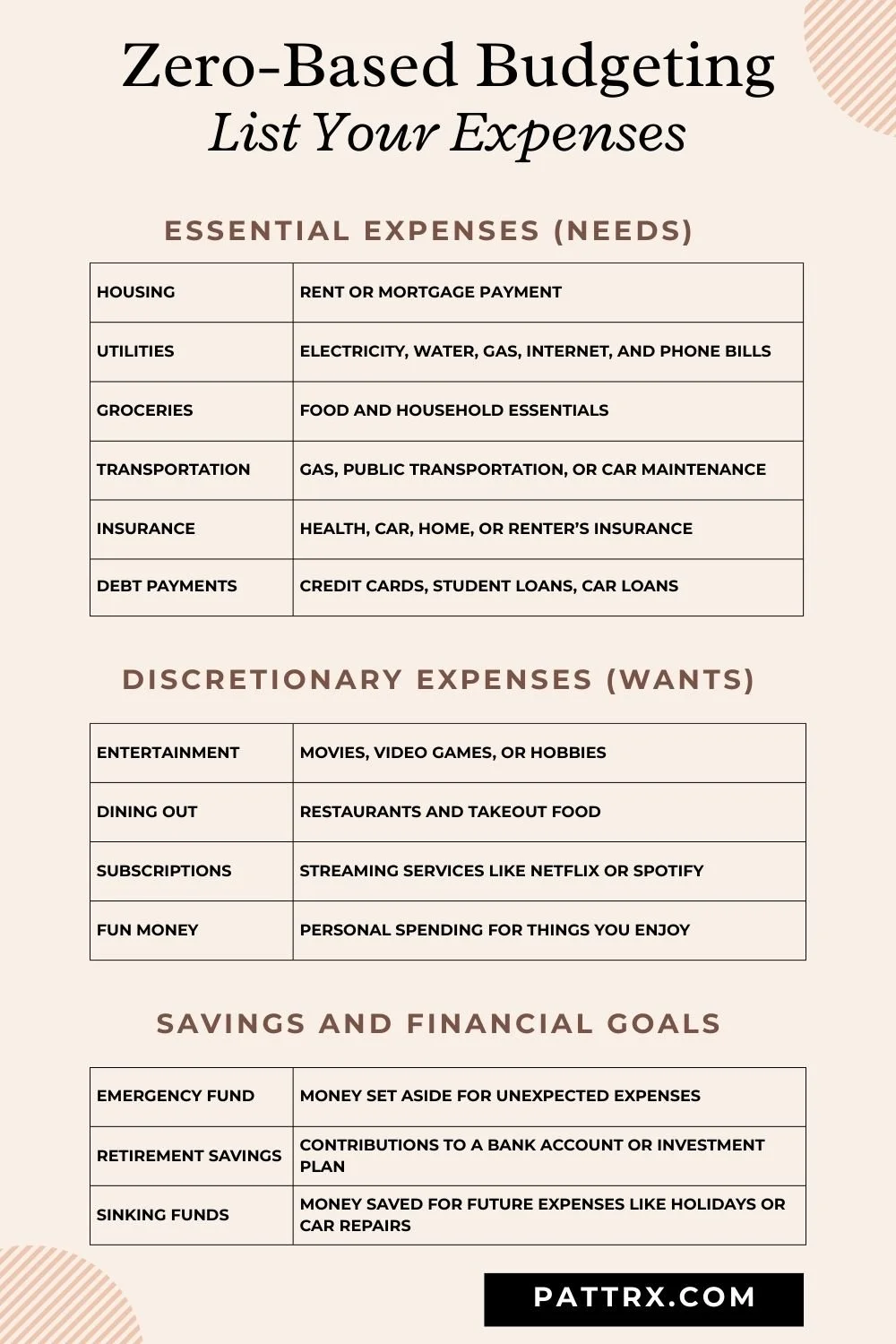
Step 3: Give Every Dollar a Job
Once you have listed your monthly expenses, the next step is to match them to your income. The goal of zero-based budgeting is to allocate every dollar so that total income – total expenses = zero dollars.
Here’s an example:
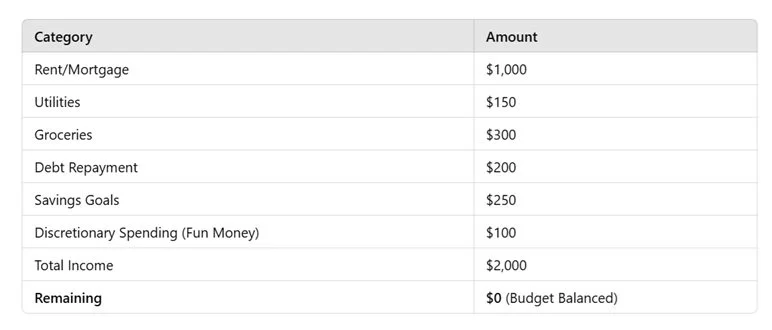
In this case, the zero-based budget work is complete—every dollar has a job! Total income was $2,000, and expenses and savings totaled $2,000.
Step 4: Track and Adjust Your Spending
Throughout the month, track your spending using, for example, a free budgeting app from GoodBudget, a notebook, or a spreadsheet.
If you spend more in one budget category, you must lower costs in another to keep your budget balanced.
Step 5: Prepare for Irregular Expenses
Not all expenses happen every month. To avoid surprise costs, save a little each month for things like:
Car repairs
Annual insurance payments
Holiday gifts
This ensures that you won’t have to use credit cards or dip into your emergency fund when these expenses come up.
(4) Conclusion
Instead of wondering where your money went, you’ll start telling it where to go—on purpose.
Are you a busy parent, a business owner, or just trying to stretch your paycheck? This method gives you a clear, simple way to make every dollar count.
You’ll create a new plan each month based on your actual income and needs.
Zero-based budgeting helps you stay focused and flexible.

Starting a zero-based budget may feel like a big change.
Still, it’s one of the smartest steps you can take to get control of your money.
It can guide you through tough times, prepare you for unexpected expenses, and help you reach goals like paying off debt or building an emergency fund.
Best of all, it works even if your income changes from month to month or if you’re new to budgeting.
And if you’re a beginner, it reassures you that you don’t need a perfect financial situation to start taking control of your money.
Now that you’ve learned the basics of how zero-based budgeting works, it’s time to take your knowledge a step further.
In the next part of this guide, “Use Zero-Based Budgeting to Save More and Spend Smarter,” we’ll explore how to save more, spend smarter, and overcome common challenges of zero-based budgeting.
Get ready to strengthen your financial confidence and make zero-based budgeting a habit you can stick with for life.
LEARN MORE / SOURCES
Bibliography / Sources
Investopedia – Zero-Based Budgeting (ZBB) Definition, How It Works, and Examples
Investopedia – Advantages and Disadvantages of Zero-Based Budgeting
Wall Street Mojo – Traditional Budgeting vs. Zero-Based Budgeting
PLANERGY – Pros and Cons of Zero-Based Budgeting
LendingTree – How to Use the Envelope Budgeting System
Actual Budget – Envelope Budgeting Overview

9 Ways to Build a Strong Retirement Savings Plan
Whether you’re starting now or improving a plan you already have, building a sound retirement strategy can help you feel more confident and less stressed.
This article will show you nine simple and smart ways to create a strong retirement savings plan.

It’s never too late to start making good choices for your future.
One of the most important steps is deciding when to start saving for retirement and how much to save.
You’ll want to have enough money to enjoy your later years without worrying about paying bills or running out of savings.
Planning for retirement can be challenging, but having a clear goal can make it much easier to protect your future.
Whether you’re starting now or improving a plan you already have, building a sound retirement strategy can help you feel more confident and less stressed.
This article will show you nine simple and smart ways to create a strong retirement savings plan.
- Set Clear Financial Goals
- Start with a Roth IRA or Traditional IRA
- Take Advantage of Employer-Sponsored Retirement Plans
- Diversify Your Investment Portfolio
- Build an Emergency Fund
- Plan for Healthcare Costs and Insurance
- Create a Monthly Budget and Monitor Spending
- Seek Professional Financial Advice
- Keep Up with Retirement Plan Changes and Rules
- Conclusion / Learn More / Sources

(1) Set Clear Financial Goals
The first step to building a strong retirement plan is setting clear financial goals. It’s important to know what you want to achieve so you can figure out how much income you’ll need each month after you retire.
For instance, if you dream of traveling, you’ll likely need to save more than if you prefer a simpler lifestyle.
A good way to start is by using a retirement calculator like the one found on Ramsey Solutions.

When calculating your retirement needs, take into account your current financial situation, age, and expected expenses. This will help you gain a rough idea of how much money you’ll need to save.
Once you have a goal, break it down into smaller, manageable steps, like saving a set amount each year or month. It’s smart to review your goals every year to make sure they still match your plans for the future. Don’t be afraid to adjust your plan as your life changes!
If you didn’t start saving early, don’t worry
There are still ways to catch up and build a strong retirement fund. Here are some smart strategies to help you make the most of your time:
Once you turn 50 or older, the IRS allows you to make catch-up contributions to your Roth IRA or Traditional IRA.
If you’re behind, consider saving more aggressively. Try to boost your savings percentage—for example, instead of saving 10% of your income, aim for 15-20%.
Look for areas in your budget where you can cut unnecessary expenses and put that money into your retirement fund instead.
If your job offers a 401(k) with an employer match, make sure you’re contributing at least enough to get the full match.
If possible, consider working a few extra years to increase your savings.
Starting late doesn’t mean you can’t build a solid retirement.
By saving more, maximizing contributions, and making smart financial choices, you can still create a secure future. The key is to act now and stay consistent!
(2) Start with a Roth IRA or Traditional IRA
An Individual Retirement Account (IRA) is a great place to start saving.
There are two main types of IRAs: the Roth IRA and the Traditional IRA. Here’s a simple explanation of each:
Roth IRA: You contribute money you’ve already paid taxes on (after-tax dollars). In retirement, your withdrawals are tax-free, which is great if you think you’ll be in a higher tax bracket when you retire.
Traditional IRA: Allows you to make contributions before paying taxes. Your taxable income is lower now, which can be helpful. However, you’ll have to pay taxes on your withdrawals in retirement.
Both types of IRAs offer valuable benefits to help your money grow.
If you’re able to start early, you’ll give your savings more time to build. And you’ll create a larger nest egg for your future.
REMEMBER: Consulting a financial advisor can help you tailor a strategy that aligns with your personal financial goals and circumstances.
(3) Take Advantage of Employer-Sponsored Retirement Plans
If your job offers an employer-sponsored retirement plan, like a 401(k), it’s a smart move to take full advantage of it.
These plans are great because your contributions are automatically deducted from your paycheck, making saving effortless.
One of the biggest perks is that many employers match a portion of what you contribute, which is essentially like getting free money to add to your retirement savings.

Over the years, this matching can significantly grow your savings, especially when you factor in the power of compound interest.
Extra Tip
Always aim to contribute enough to get the full employer match. It’s like giving yourself a pay raise without doing any extra work! Skipping this match is like leaving free money on the table.
(4) Diversify Your Investment Portfolio
When saving for retirement, it’s important to spread your money into different types of investments instead of keeping it all in one place.
This is diversification, and it helps lower your risk.
Think of it like not putting all your eggs in one basket—if one investment doesn’t do well, the others can help balance things out.
A good retirement savings plan includes a mix of different types of investments, such as:
Mutual Funds: These are groups of stocks and bonds that professionals manage. They help your money grow while also keeping things stable.
Bond Funds: These are safer investments that pay steady interest. They don’t grow as fast as stocks, but they help keep your savings steady during rough times in the market.
Real Estate: Buying property can earn you money if you rent it out, and the value of the property may also go up over time. This can give you both short-term and long-term financial benefits.

REAL ESTATE AS AN INVESTMENT
By diversifying—spreading out your investments—you can protect your savings from big losses.
If one type of investment isn’t doing well, the others might still be growing. This balance helps protect your savings.
It’s also important to check your investments from time to time. Make sure they still match your financial goals and the amount of risk you’re comfortable with.
As you get closer to retirement, adjust your investment if needed.
(5) build an emergency fund
Life is full of surprises. And sometimes those surprises come with a big price tag.
Whether it’s an unexpected medical bill, a sudden car repair, or an urgent home maintenance issue, having a financial safety net can make a huge difference.
That’s why creating an emergency fund is such an important part of any retirement savings plan.
An emergency fund is a separate savings account with enough cash set aside specifically for these unplanned expenses.
A good rule of thumb is to save at least three to six months’ worth of living expenses.
This means calculating the amount you need to cover basic costs such as rent or mortgage, utilities, groceries, and insurance.

It’s also smart to keep your emergency fund in a high-yield savings account. These accounts typically offer higher interest rates than regular checking accounts. This lets your money grow faster over time.
Even though the money is set aside for emergencies, it’s still working for you by earning interest.
Extra Tip
Set up automatic transfers to your emergency fund each month. For example, if you automatically move $50 to $100 into your emergency fund every paycheck, you’re building your safety net without even thinking about it. This makes saving effortless and helps you stay consistent.
Additional Advice
Keep your emergency fund separate from your everyday checking account. This way, you’re less tempted to dip into it for non-emergencies.
Plus, it will be easier to track how much you’ve saved specifically for emergencies.
(6) Plan for Healthcare Costs and Insurance
Healthcare can be a major expense in retirement, so it’s smart to plan for it now.

One great way to prepare is by opening a health savings account (HSA) if you have a high-deductible health plan.
An HSA allows you to save money for medical expenses, and the contributions are tax-deductible.
Even better, your money grows tax-free, and withdrawals for qualified medical expenses are tax-free, too!
It’s also a good idea to look into life insurance and long-term care insurance. These options can protect you and your family from unexpected medical bills or the high costs of nursing home care.
This gave you peace of mind, knowing that your medical expenses would be covered and that they wouldn’t leave your family with huge bills.
(7) Create a Monthly Budget and Monitor Spending
Having a monthly budget is like having a plan for your money.
It helps you see where your money goes and gives you the chance to adjust your spending.
When you create a budget, list all your income sources, like your paycheck, and all your expenses, including what you’re saving for retirement.
Review your budget regularly to make sure you’re staying on track and not spending too much on discretionary expenses.
If you find areas where you can cut back, put that extra money into your retirement savings.
Extra Tip
Using a budgeting app can make it easy to track your spending and stay organized.
(8) Seek Professional Financial Advice
Retirement planning can be a little confusing at times, and that’s okay!
A financial advisor or a registered investment advisor can help you make good decisions and create a plan that fits your specific needs.
They offer investment advice and can help you with things like planning for unexpected expenses, creating an investment strategy, and minimizing taxes.
Working with a financial advisor can help you avoid common mistakes and make sure you’re on the right path to reaching your retirement goals.
When choosing a financial advisor, look for someone with experience in retirement planning and good reviews from other clients.
(9) Keep Up with Retirement Plan Changes and Rules
Laws and rules about retirement accounts change from time to time, so it’s important to stay informed.
For example, changes to social security benefits or tax rules can impact how much you can save and withdraw in retirement.
Review your plan every year and update it as needed.
This will help you avoid penalties for early withdrawals and ensure that you’re taking advantage of all the current rules.
Keeping up with changes helps keep your retirement plan strong and on track.
Conclusion

By setting clear financial goals, investing in a Roth IRA or Traditional IRA, and diversifying your portfolio, you’re building a secure future.
Remember to save for healthcare costs, budget wisely, and seek professional advice if needed.
Start today and take one step toward building a strong retirement savings plan.
Your future self will thank you!
The earlier you start, the more you’ll benefit from all the hard work you’re doing now.
LEARN MORE / SOURCES
Young, Gina. “Roth IRA vs. 401(k): What’s the Difference?” Investopedia, 3 Oct. 2014.
Burnette, Margarette. “Emergency Fund: What It Is and Why It Matters.” NerdWallet, 30 Nov. 2017.
Holmes, Tamara E. “The Million Dollar Retirement Myth Debunked.” AARP, 5 May 2023.
Income Diversification: Creating a Plan to Support Your Lifestyle in Retirement.

Going from Paycheck to Paycheck to Financial Freedom

Living paycheck to paycheck can feel like an endless cycle of working hard but never getting ahead.
And waiting impatiently for your next payday to cover bills can be frustrating.
The financial stress and anxiety you feel can make it hard to focus on anything but trying to make ends meet.
But imagine a life where you’re not just surviving from one payday to the next but actually building a solid financial foundation.
In this article, we’ll explore how, with a few small changes, you can stop relying on every paycheck and look forward to a more secure and enjoyable future.
- Understanding the Paycheck-to-Paycheck Cycle
- Evaluating Your Financial Situation
- Building a Safety Net with Emergency Savings
- Reducing High-Interest Debt
- Budgeting for Long-Term Financial Health
- Growing Your Income with Side Hustles
- Investing for a Strong Financial Future
- Developing Long-Term Financial Habits
- Celebrating Progress and Adjusting Goals
- Conclusion / Related Articles / Sources
(1) UNDERSTANDING THE PAYCHECK-TO-PAYCHECK CYCLE
Many Americans live paycheck to paycheck. Each paycheck is almost entirely used to cover basic expenses before the next paycheck arrives.
According to a 2023 survey by LendingClub, many Americans are in the same situation. In fact, 63% of adults reported living paycheck to paycheck, including 40% of those earning over $100,000 annually.
The paycheck-to-paycheck lifestyle can lead to financial strain, especially when unexpected expenses like car repairs or medical bills happen.
If you don’t have emergency savings, a sudden need for extra cash can leave you in more debt. You may be relying on credit cards or loans to make ends meet. If so, then you are creating a cycle of high-interest debt.
Understanding the paycheck-to-paycheck cycle is the first step towards escaping it and building a stable financial future.
(2) Evaluating your financial situation
Start by taking a closer look at your monthly expenses, debt, and income.
Budgeting is one of the most important tools for getting control of your finances and breaking the paycheck-to-paycheck cycle.
Use a budget to see where your money goes each month. Break down your expenses into:
Fixed — For example, rent and car payments, or
Variable — For example, eating out or shopping.
Tracking monthly expenses can help you identify areas where you might cut back and free up extra dollars to build your savings or pay down your debt.
REVIEW THE 5 QUICK STEPS TO CREATING A BUDGET
A budget doesn’t have to be restrictive.
By sticking to a budget, you’re more likely to reach your financial goals, whether that’s building an emergency fund, paying off debt, or saving for something special.
Think of a budget as a guide that helps you make smart financial choices.
A budget will help you see exactly where your income is going. It will also make it easier to find areas where you can cut back or save.

CAN YOU MAKE A SIMPLE CHANGE TO YOUR SPENDING?

If you spend $10 a week on coffee, that’s $520 a year!
By cutting back or making coffee at home, you could put that money into an emergency fund.
Each month, review your spending to see if you stayed within your budget and identify any changes you might need to make for the next month.
Over time, budgeting will become easier, and you will feel more in control of your money, bringing you one step closer to financial freedom.
(3) BUILDING A SAFETY NET WITH EMERGENCY SAVINGS
Create an emergency fund to handle unexpected expenses. Having an emergency fund means you can rely less on credit cards.
Experts recommend saving three to six months’ worth of living expenses. While that may seem like a lot, starting small is okay.
Aim for a few hundred dollars as a short-term goal.
Even a small emergency fund can give you peace of mind, knowing there’s some cushion for minor setbacks.
where to keep your MONEY?
A high-yield savings account is a good choice for emergency savings.
It offers higher interest than a regular savings account.
Your money can grow while still being easily accessible when you need it.
Gradually adding to your savings fund over time helps build a larger safety net.
It can stop debt from piling up when surprises happen.
When you consistently set aside a little extra cash, you’ll create a financial buffer that can protect your long-term goals.

(4) REDUCING HIGH-INTEREST DEBT
High-interest debt, like credit cards, is a a major burden to many people.
High interest rates mean that a big part of your payment goes to interest rather than lowering the actual debt.
So, if you’re only paying the minimum each month, your debt can grow quickly, making it feel like you’re stuck paying the debt forever.

This cycle can create a lot of anxiety, especially if you’re juggling multiple credit cards or loans.
As of May 2024, the average credit card interest rate for accounts assessed interest was 22.76%.
How can you reduce your debt?
Struggling to get out of debt from loans and credit cards can seem impossible.
Monthly payments can stretch your budget thin while balances grow.
There are strategies you can use to make it easier to regain control. It will improve your credit scores and free up cash.
And by freeing up cash, you will have more money available for savings and investment opportunities.
There are several approaches to debt relief, but two of the most popular are the avalanche and snowball methods—each with its own approach to clearing debt and moving closer to financial freedom.
Debt Avalanche Method
The avalanche method focuses on paying off debts with the highest interest rates first. This saves money on interest in the long run.

Debt Snowball Method
The snowball method focuses on paying off the smallest debts first. This helps you gain momentum as you eliminate each debt.
Many people find this more rewarding than the avalanche method because it keeps you feeling motivated.
Whichever method you choose, both methods can help you pay down your debt and reach your financial goals.
Choosing the best method for you depends on what keeps you motivated and what your goals are.
(5) BUDGETING FOR LONG-TERM FINANCIAL HEALTH
Creating a monthly budget will help you control your spending so your savings can grow.
Start by listing all your income and necessary expenses for the month, like rent, utilities, and groceries. Cut back on areas of over-spending.

As you fine-tune your budget, remember to set aside funds for variable expenses, like car repairs or seasonal bills, such as home heating costs. This will help you avoid surprises.
Be sure to assign money toward your debt repayment and savings.
Sticking to a budget will take practice, but over time, it will help you build healthier financial habits. Review and adjust your budget regularly to reflect any changes in your income or expenses.
(6) Growing Your income with side hustles
A side hustle can help you reach financial goals faster.
Whether it’s freelancing, selling items online, or part-time work, earning extra income can boost your savings or help you pay off your debt faster.
Popular Side Hustles:
Freelance writing or graphic design
Dog walking or pet sitting
Selling handmade goods online
SIDE HUSTLES FOR BEGINNERS | HOW TO START A SIDE HUSTLE
Make sure the income from your side hustle goes directly toward savings, debt reduction, or investments to help you get closer to financial independence.
Growing your income with a side hustle or part-time job can be a powerful way to boost your financial progress, especially if you’re working to break the paycheck-to-paycheck cycle.
Earning extra money allows you to put more toward savings, debt repayment, or even start an investment portfolio.
Side hustles don’t have to take up all your free time; even a few hours a week can make a difference. For example, driving for a ride-share service or selling handmade crafts online can be flexible options that fit into a busy schedule.
The key is to choose something that works with your lifestyle and aligns with your skills and interests.

Some employers offer overtime pay or opportunities for extra shifts, which can be a great way to increase income without needing to balance multiple jobs.
Alternatively, asking for a raise or exploring advancement opportunities at work can lead to a long-term income boost.
The important thing is to find creative ways to grow your income in a way that supports your goals without overwhelming your schedule.
(7) Investing for a Strong Financial Future
Once you’ve built some savings and reduced high-interest debt, it’s time to start investing.
Investments, like retirement accounts, grow over time and can build a nest egg for the future. Retirement accounts like a Roth IRA offer tax benefits and grow your money through compounding.
Building an Investment Portfolio
Start with low-risk investment products, like index funds, which spread risk across a variety of assets.
Financial Advisor Help
If investing feels overwhelming, consulting a financial advisor can help. They can guide you in setting goals, building an investment strategy, and managing risks.
INVESTMENT Tip
The earlier you start investing, the more time your money has to grow. Even small investments each month can add up over time.
(8) Developing LONG-TERM Financial Habits
Financial freedom isn’t achieved overnight
Developing good financial habits, like tracking expenses and setting goals, helps maintain long-term stability.
Regularly reviewing your budget, goals, and spending can help you stay on track and reach new financial milestones.
Setting Financial Goals
Goals can be as simple as saving $500 or as big as owning a home. Write them down and review your progress monthly. Adjust them as your financial situation improves.
(9) Celebrating Progress and Adjusting Goals

Recognize and celebrate your milestones.
Paying off a credit card or reaching a savings target is cause for celebration.
Reward yourself in a budget-friendly way, like having a movie night at home whenever you reach a milestone.
Celebrating progress keeps you motivated and makes the journey more enjoyable.
As your financial situation changes, adjust your goals to keep moving toward financial freedom.
(10) CONCLUSION
Moving from a paycheck-to-paycheck lifestyle to financial freedom takes patience.
But each step brings you closer to financial independence and peace of mind.
By setting goals, building an emergency fund, tackling high-interest debt, and investing wisely, you can create a secure financial future.
Start today by setting a small goal or automating a savings transfer. Each step brings you closer to a life free from financial stress.
Ready to make real progress?
Make one small change, and watch your financial future improve with each step.
RELATED ARTICLES
SOURCES

50 Tips for College Students with Limited Funds
In this article, I’ll give you 50 tips to help you and the students in your life manage their money wisely so college life can be both enjoyable and financially secure.

College can be fun and exciting, but it also comes with money challenges.
Many college students have to learn how to handle limited finances while working towards a college degree or a specialized trade.
With costs like student loans, tuition, and daily expenses, it's important to learn good money management skills.
In this article, I’ll give you 50 tips to help you and the students in your life manage their money wisely so college life can be both enjoyable and financially secure.
UNDERSTANDING FINANCES
(1) Know Your Finances
Understand your total money coming in and your monthly expenses going out. This gives you a clear picture of your overall finances and helps you make informed decisions.
Tools like Microsoft Excel can help you track your spending and income.
Microsoft Excel offers free worksheets to help you personalize your budget.

(2) Set Realistic Goals
Setting money goals is the first step to being financially stable.
Whether you want to save for textbooks or earn money from a summer job, having clear and realistic goals will help you stay focused.
Break your goals into short-term ones (like saving for books) and long-term ones (like saving for a car), and change them as needed during your college years.
(3) Track Your Spending
Keeping an eye on how you spend your money is the key to not overspending.
Have you tried the envelope system, also called cash stuffing?

When you use the envelope/cash stuffing system, you put cash in different envelopes for specific expenses.
This helps you stick to your college budget and avoid buying things you don't need.
(4) Know budget basics
Know the basics of budgeting.
Start by splitting your expenses into fixed costs (like rent or tuition) and variable expenses (like eating out or entertainment).
This will help you figure out what you must spend money on and where you can save.
The following video, “Make a Budget in 5 Steps,” is an excellent watch for anyone new to budgeting and also for anyone needing a refresher. If you’re new to budgeting, it may get tricky, but with practice and patience, you can accomplish the task.
(5) Understand Financial Literacy
Learning about money management is fundamental. Think about taking a personal finance class or attending workshops about budgeting, saving, and investing.
You can also watch free YouTube courses or borrow library books on the subject.
Knowing about personal finance will help you make smarter money choices throughout your life.
MONITORING FUNDS
(6) Open a Checking and Savings Account
Having a checking account for everyday spending and a savings account for future goals is important.
Look for a bank or credit union that offers low fees and reasonable interest rates.
Credit unions are a good choice because they often have better interest rates and lower fees than big banks.
(7) Start Building an Emergency Fund
An emergency fund will help you deal with unexpected costs, like car repairs or medical bills.
Start by saving a small amount of money each month—just $20 can add up over time. Keep this money in a savings account that you can easily access if you need it.

GET STARTED ON YOUR EMERGENCY FUND
(8) Monitor Your Credit Score
Your credit score is vital for your financial future.
A good credit score can help you get low-interest-rate loans and other financial benefits. Use free services to check your credit score regularly and make sure it stays in good shape.
(9) Understand Debit CARDS VS Credit Cards

Debit cards help you avoid debt because you can only spend the money you already have.
Credit cards can be helpful if you use them responsibly.
Only use a credit card for emergencies or small purchases that you can pay off completely each month to avoid debt and interest costs.
This will help you build a good credit score without piling up debt.
(10) Automate Your Savings
Automating your savings is a great way to make sure you're always putting money aside.
Set up automatic monthly transfers from your checking account to your savings account, even if it's just a small amount. This helps you save money without having to think about it.
BOOKS TO HELP STUDENTS & PARENTS TAKE THE WORRY OUT OF FINANCIAL PLANNING


MAKE budget cuts
(11) Create a College Budget
Start by figuring out how much money you make each month.
This includes financial aid, money from a part-time job, and any help from your family. Then, list out all your monthly expenses, like rent, groceries, transportation, and fun activities.
Make sure your income is enough to cover your expenses, and change your spending if necessary so you don’t go over budget.

The Clever Fox Budget Planner & Bill Organizer helps you manage household and personal finances in one place, keeping track of savings, debt, bills, and expenses.
It allows you to create a budget, monitor daily spending, and store bills with 12 laminated pockets for organization.
The planner helps you set and achieve financial goals by breaking them into manageable steps.
It features a large format, durable eco-leather cover, spiral binding, budgeting stickers, a user guide, and comes in a keepsake gift box.
(12) Take Advantage of Student Discounts
Many businesses offer discounts to college students, so always ask if there’s a discount available when you buy something.
Movie theaters, public transportation, and online streaming services often offer student discounts, which can save you a lot of money over time.
(13) Buy Used Textbooks

Instead of buying new textbooks, consider buying used, or using online resources to save money on school materials.
Many websites offer cheaper digital versions of textbooks or allow you to rent them for a fraction of the cost.
You can also check if your campus library has the textbooks you need available for free.
(14) Limit Eating Out
Eating out often can quickly drain your money.
Restaurant meals often cost significantly more than cooking at home, especially when you add drinks, tips, and extra fees.
Portions are usually larger than necessary, leading to waste and unnecessary spending.
Frequent dining out also makes it harder to track your expenses, as small purchases like coffee or snacks can add up quickly without you realizing it.
(15) Save on Transportation Costs

Think about using public transportation, biking, or walking instead of owning a car.
Cars can be expensive because of costs like gas, parking, and maintenance. You can save a lot of money each month by choosing cheaper options.
IncreasE funds
(16) Get a Part-Time Job
Working part-time while you're in college is a simple way to make extra money. Many colleges have on-campus jobs that will fit around your class schedule.
Try to find jobs that match your interests or help you build useful skills.
(17) Apply for Financial Aid and Scholarships
Make the most of financial aid by applying for scholarships, grants, and work-study programs.
Remember to fill out the FAFSA (Free Application for Federal Student Aid) every year because your need for financial aid might change as your financial situation changes.

(18) Consider a Summer Job
Take advantage of your summer break by getting a summer job to earn extra money. This is a good time to save up for the next school year, which can help you borrow less in student loans.
(19) Start a Side Hustle
A side hustle is a fun way to make some extra money.
You could offer tutoring, do freelance writing, or sell handmade crafts online, to name a few. Some side hustles mentioned in the video were dog walking, pet sitting, car detailing, and videography.
This extra cash can help you pay for expenses or add to your savings.
(20) Sell Unneeded Items
Clear out your space and make money by selling things you don't need anymore.
Items like old textbooks, clothes, and electronics can be sold for a decent price, giving you extra money to put toward your financial goals.
debts and loans
(21) Understand Your Student Loans
Student loans can be tricky, but you need to know how they work.
Federal student loans usually have better terms than private loans, lower interest rates and more flexible repayment options.
Use online calculators to figure out your monthly payments and see how loans will affect your future finances.
(22) Borrow Only What You Need
When you take out student loans, only borrow what you need to pay for things like tuition, books, and housing.
Avoid using loans for things you don't absolutely need. It all adds to your student debt.
(23) Pay Interest While in School
If you can, try to start paying off the interest on your student loans while you're still in school.
Even small payments can help reduce the total amount you owe and keep your debt from increasing.
(24) Keep Track of Your Loan Balance
Regularly check your loan balance to stay aware of how much you owe. This helps you plan for repayment and avoid surprises after graduation.
Many loan servicers provide online portals for easy access to your account information.
(25) Understand the Grace Period
Most student loans offer a grace period, typically six months after graduation, before repayment begins.
Use this time to plan your budget and explore repayment options.
SMART MONEY MATTERS
(26) Choose Affordable Housing
Housing is often the biggest expense for college students. To save money, think about living on campus or sharing an apartment with roommates.
Sometimes living off-campus can be cheaper, but make sure to include transportation and other costs when making your choice.
(27) Limit Subscription Services
Subscription services like streaming platforms and monthly subscription boxes can get expensive fast.
Check which ones you really use and think about canceling the ones you don't.
You can also save money by sharing subscriptions with your roommates.
(28) Use Cash Instead of Cards
Using cash can help you stick to your budget because it limits your spending to the money you have on hand. This can help prevent overspending and make it easier to manage your money.
It helps you control your spending. You’re limited by the amount of cash you have. Once the cash is gone, you can’t spend any more. When using cards, it’s easy to swipe and spend more than you planned.
(29) Cook at Home and Meal Prep
Cooking your meals at home is a great way to save money on food.

By preparing meals for the week ahead, you can avoid eating out. Be sure to have healthy, budget-friendly meals ready to eat.
POPULAR AMAZON PRODUCTS FOR EASY Food Prep


(30) Avoid Impulse Purchases
Buying things on impulse can mess up your budget.
To avoid spending money on things you don't need, use the 24-hour rule: wait a day before buying something, and if you still want it after 24 hours, it might be worth buying.
PLAN FOR SUCCESS
(31) Start Building Good Credit Habits
Developing good credit habits now will help you in the future.
For example, paying your bills on time and keeping your balances low can improve your credit score.
And a good credit score will make it easier to get loans, rent apartments, and even get better interest rates later on.

PAYING BILLS ON TIME IMPROVES YOUR CREDIT SCORE
(32) Plan for Future Financial Goals
Start thinking about your financial future by creating a savings plan.
Whether you’re saving for a down payment on a car or starting a retirement fund, having clear goals will keep you focused and motivated.
(33) Invest in Mutual Funds or Savings Bonds
Investing in mutual funds or savings bonds is a smart way to grow your money over time.
Even as a student, you can start investing small amounts. This allows you to benefit from compound interest and build a strong financial foundation for the future.
(34) Create a Monthly Savings Goal
Saving even small amounts of money regularly can add up over time.
Set a monthly savings goal that fits your income. For example, saving $50 from your part-time job each month can lead to big savings by the end of the year.
(35) Start a Retirement Account

It’s never too early to start saving for retirement.
Think about opening a Roth IRA (Individual Retirement Account) using part of your earnings. If your job offers a 401(k) plan, you should use it, especially if they add money to it.
This can help your retirement savings grow faster.
Starting early lets you take advantage of compound interest, which can greatly increase your savings over time.
PLAN FOR EMERGENCIES
(36) Set Up an Emergency Fund

HAVING AN EMERGENCY FUND IS CRUCIAL FOR FINANCIAL STABILITY
An emergency fund should be used to cover unexpected expenses, such as car repairs or medical bills. Aim to save at least three to six months' worth of living expenses in a separate savings account.
(37) Have a Backup Plan for Financial Support
Sometimes, even the best financial planning can't prevent a financial crisis. Make sure you have a backup plan, such as financial support from family members or a small personal loan, to cover unexpected costs.
(38) Review Your Budget Regularly
Your money situation can change during the year, so it’s important to check and update your budget often.
Budgeting apps can help you stay up to date on your income and payment. Review the following free apps.
BUDGETING APPS - THESE VERSIONS ARE FREE
Customizes categories
Sets due dates for bills
Prioritizes payments
User-friendly interface
Manual expense tracking
Tracks monthly expenses and net worth
Gives you access to TransUnion and Equifax credit reports
Offers money management tools
Only tracks month-to-month, not yearly
Manages manually added purchases
Digitizes the envelope budgeting method
Gives you 20 envelopes for organizing your finances
Reviewing your budget at least every two months (preferably every month) will help you make changes and continue reaching your financial goals.
(39) Be Prepared for Medical Expenses
Sometimes, unexpected medical costs happen.
Make sure to budget for your health insurance payments and set aside extra money for medical costs.
Many colleges offer basic healthcare services like check-ups, vaccinations, or mental health help at a low cost or even for free. Using these services can save you money while making sure you get the care you need.
(40) Avoid Overdraft Fees
Overdraft fees can quickly eat away at your bank account. Set up alerts for low balances, link your checking account to a savings account, or opt for overdraft protection to avoid these costly fees.
THE COLLEGE EXPERIENCE
(41) Use Campus Resources
College campuses offer a variety of resources that can help you save money. From free food at campus events to free or low-cost entertainment, take advantage of what your college has to offer.
These resources can help you make the most of your college experience without spending a lot of money.
(42) Participate in Free or Low-Cost Activities
There are plenty of free or low-cost activities you can participate in during your college years.
Join clubs, attend workshops or volunteer for campus events. These activities not only save money but also provide opportunities to meet new people and gain valuable experience.
(43) UTILIZE CAMPUS RESOURCES FOR ACADEMIC HELP
College campuses often offer free resources to help students succeed academically.

Take advantage of tutoring services, study groups, or professor office hours.
Many schools also provide access to free software, research databases, and academic workshops.
Using these resources can reduce the need for expensive private tutoring while helping you excel in your studies.
Taking full advantage of what's available on campus can save both time and money.
(44) Limit Social Spending
Socializing is an important part of college life, but it can be expensive.
Instead of going out every weekend, consider hosting movie nights or potlucks with friends. This way, you can still have fun without overspending.
(45) Share Expenses
Living with roommates is a great way to reduce living expenses.
Share costs for groceries, utilities, and other household items. By splitting these costs, you can save a significant amount of money each month.
AMAZON BUDGET-FRIENDLY GADGETS


LIFE AFTER COLLEGE

(46) Build a Network for Future Job Opportunities
Networking is key to finding job opportunities after graduation. Build relationships with professors, alumni, and professionals in your field.
Attend alumni events, career fairs, and networking workshops to expand your network.
(47) Plan for Paying Off Student Loan Debt
Start planning for student loan repayment before you graduate. Explore different repayment plans, consider setting up automatic payments, and look into loan forgiveness programs if you qualify.
Having a plan in place will make managing student loan debt more effortless.
(48) Start a Post-Graduation Savings Plan
Saving for life after college is vital, especially if you plan to relocate or job-hunt.
Set aside money specifically for post-graduation expenses, such as moving costs or professional attire.
This will give you a financial cushion as you transition into the workforce.
(49) Seek Financial Advice
If you're unsure about how to manage your finances, seek advice from a financial advisor or use campus financial resources.
Many colleges offer free financial counseling to students.
Taking advantage of this support can help you make informed financial decisions.
(50) Maintain Healthy Financial Habits
The financial habits you develop in college will carry over throughout adulthood. Continue to practice good budgeting, saving, and spending habits even after you graduate.
By maintaining these habits, you'll be well on your way to achieving long-term financial stability.
LEARN MORE ABOUT IT

Financial Goal Setting for High School Students
Financial literacy is a cornerstone of responsible adulthood in today's rapidly evolving economic landscape, yet it remains a skill often underrepresented in traditional high school curricula.

Financial literacy is a cornerstone of responsible adulthood in today's rapidly evolving economic landscape, yet it remains a skill often underrepresented in traditional high school curricula.
Parents, teachers, and counselors play a key role in bridging this educational gap so that these students can become financially savvy citizens.
This article is dedicated to empowering high school students with insights, strategies, and tools to instill a strong financial foundation.

(1) HAVE A FINANCIAL GOAL
What is a financial goal?
A financial goal is the expected outcome of saving, spending or investing a specific amount of money within a certain amount of time.
For high school students, setting financial goals is an important step toward financial literacy.
Using goals, they can learn the value of money, the importance of saving, and the benefits of planning ahead.
Goal setting will help them manage their personal finances, allowing them to meet their current needs and future dreams. In short, they learn to prioritize spending, avoid unnecessary debt, and set financial goals.
Types of Financial Goals
Financial goals can be classified into short-term, medium-term, and long-term goals. Each serves a different purpose and time frame.
BEST SELLING AMAZON FINANCIAL BOOKS FOR TEENS & YOUNG ADULTS


Short-Term Goals
These are objectives that can be achieved within a year or less.
For high school students, short-term goals might include saving enough money for a new phone, buying a prom dress or suit, or setting aside a certain amount for a summer trip.
Short-term goals encourage students to practice regular saving habits and make conscious spending decisions, providing immediate rewards for their efforts.
Medium-Term Goals
Medium-term goals are typically set for achievements that take one to five years.
Examples could include saving enough money to cover the total cost of a school trip abroad. These goals require a more disciplined approach to saving and possibly earning extra income through part-time jobs or side hustles.
Long-Term Goals
Long-term goals extend beyond five years and often involve significant financial planning and commitment.
This might include saving for college to avoid high student loan debt.
Achieving long-term goals requires a deep understanding of financial planning, investment, and the power of compound interest.
(2) EXAMPLES OF Financial Goals FOR STUDENTS
Examples of Short-Term Financial Goals (Achievable in 1 year or less)
Saving for a Concert Ticket: Setting aside money from allowances or part-time jobs to buy a ticket to see a favorite artist perform.
Buying a Prom Dress or Suit: Saving enough money to purchase attire for the prom without needing to ask parents for money.

EXAMPLE OF SHORT-TERM FINANCIAL GOAL, SAVING MONEY FOR A PROM DRESS
Purchasing School Supplies or Tech Gadgets: Accumulate funds to buy new school supplies or tech gadgets (like headphones or a calculator) for the upcoming school year.
Starting an Emergency Fund: Creating a small emergency fund of $100-$300 for unexpected expenses.
Saving for Holiday Gifts: Saving money throughout the year to buy gifts for family and friends during the holidays.
Examples of Medium-Term Financial Goals (1 to 5 years)
Saving for a Car: By the end of high school, accumulate enough money for a down payment on a used car.
Funding a College Savings Account: Contributing to college savings account to support tuition or books.

EXAMPLE OF MEDIUM-TERM FINANCIAL GOAL, SAVING MONEY TOWARD COLLEGE TUITION
Investing in a High-Quality Laptop: Saving for a high-quality laptop that will last through college years.
Planning a Graduation Trip: Setting aside money each month for a senior year trip with friends.
Starting a Small Business: Saving enough seed money to start a small online business or side hustle.
Examples of Long-Term Financial Goals (Beyond 5 years)
Funding College Education: Saving and investing to cover college tuition and living expenses, minimizing student loan debt.
Buying a House: Starting a savings account specifically for a future home down payment.

EXAMPLE OF LONG-TERM FINANCIAL GOAL, SAVING MONEY FOR A HOME DOWN PAYMENT
Investing for Retirement: Beginning to invest in a retirement account, even in small amounts, to take advantage of compound interest.
Saving for World Travel: Creating a savings plan to afford a major world travel adventure after completing education.
Establishing a Charity Fund: Saving and planning to establish a fund for a charitable cause that you are passionate about.
(3) Setting SMART Financial Goals
The SMART framework is a powerful tool for setting effective financial goals, especially for high school students beginning to navigate the complexities of personal finance.
This method encourages setting Specific, Measurable, Achievable, Relevant, and Time-bound goals, providing a clear roadmap toward financial success.
SPECIFIC — Have a clear and specific financial goal. For example, saving for a new laptop computer.
MEASURABLE — Set goals with a clear amount of money in mind.
ACHIEVABLE—Set realistic goals for a high schooler’s income, perhaps a part-time job or working during the summer.
RELEVANT — Ensure these goals align with your personal ambitions and future career.
TIME-BOUND — Set a time frame for achieving goals.

Specific
A specific goal is much more likely to be accomplished than a general one. To set a specific financial goal, students should define exactly what they want to achieve, including the details of how they plan to achieve it.
For example, instead of saying, "I want to save money," a more specific goal would be, "I want to save $500 for a new laptop by the end of the year." This clarity helps focus efforts and resources effectively.
Measurable
Setting measurable goals means defining how much money needs to be saved and tracking progress toward that amount. Be able to answer the question, "How much?" or "How many?"
For instance, to save $500 for a new laptop, high school students can measure progress by checking how much they've saved each month. This way, they can stay motivated and adjust their plans if they’re falling short.
Achievable
To be successful, a goal should be realistic and attainable. This means considering a high schooler's financial resources, such as income from a part-time job, gifts, or summer work.
If a student earns $100 a month from a part-time job, setting a goal to save $500 in five months is achievable if they can save $100 each month. It's important to set goals that stretch their abilities but remain possible.
Relevant
A relevant goal should align with broader personal ambitions, values, or future career paths. This ensures that the effort put into achieving the goal is worthwhile and motivating.
Saving for a laptop might be especially relevant to high school students who plan to study computer science in college or pursue a career in digital arts. The goal should support their long-term objectives and immediate needs.
Time-bound
Every goal needs a deadline to prevent everyday tasks from taking priority. By setting a time frame, such as "by the end of the year" or "before the start of the next school term," students can create a sense of urgency and work steadily towards their goals.
Time-bound goals help prioritize savings and spending, making it easier to decline unnecessary expenses that could derail plans.
By applying the SMART standards to financial goal setting, high school students can create a structured and focused approach to managing money.
This not only helps them achieve their current financial goals, such as buying a new laptop or saving for a car, but also lays the foundation for lifelong financial planning and success.
(4) Strategies for Achieving Financial Goals
Whether it's saving for a new gadget, funding higher education, or simply building a safety net, these steps provide a solid foundation for financial planning and decision-making.
Create a Budget
A budget is a plan that outlines expected income and expenses over a certain period, helping to manage money effectively.
Make a realistic budget that includes savings for short-term and long-term goals.


A budget helps students prioritize their financial goals and provides a clear picture of where their money is going, making it easier to make adjustments and stay on track.
SavingS ACCOUNT
Encourage students to open savings accounts if they haven't already. Savings accounts not only keep money safe but also earn interest over time, helping students grow their savings.
Earn Extra Money
Increasing income is another strategy for achieving financial goals faster. Students can consider:
Part-Time Jobs: Working after school or on weekends can provide a steady source of income.
Summer Work: Taking on full-time work during the summer months can significantly boost savings for long-term goals.
Side Hustles: Creative or entrepreneurial ventures, such as selling handmade goods online, tutoring, or freelance writing, can be flexible ways to earn extra money.
Minimize Expenses
Reducing unnecessary spending is essential for saving more money.
Here are some tips:
Identify and cut non-essential expenses. Distinguish between wants and needs, and try to limit spending on non-essentials.
Look for discounts and deals. Use student discounts, buy second-hand, or trade items with friends to save money.
Achieving financial goals requires a strategic approach, especially for high school students who are just beginning to understand the complexities of personal finance.
Here are some strategies that can help students reach their financial objectives:
Practice mindful spending. Before making a purchase, consider if it's necessary and how it fits into the budget and financial goals.
By applying these strategies, high school students can effectively work towards their financial goals and develop good habits that will benefit them throughout their lives.
(5) Overcoming Common Financial Challenges
Financial challenges are a part of life, but with the right strategies, high school students can learn to navigate these obstacles effectively.
Here are some ways to manage common financial hurdles:
Managing Unexpected Expenses
Unexpected expenses, such as a sudden repair or medical bill, can derail financial plans. To prepare for these unforeseen costs build an emergency fund.
What is an emergency fund? An emergency fund is a savings account specifically set aside for unexpected expenses.
Starting small, like saving a portion of a part-time job or gift money, can gradually build a safety net. Ideally, this fund should cover 3-6 months of living expenses, but even a small amount can provide a buffer against financial stress.
Avoiding Debt
Debt can be a significant barrier to financial stability, especially if not managed wisely.
Understanding Good vs. Bad Debt
Educate students on the difference between good debt, which can be an investment in their future (like student loans for higher education), and bad debt, which offers no return and can carry high-interest rates (like credit card debt).
Credit Cards
If using a credit card, it's important to pay the balance in full each month to avoid interest charges.

Credit cards should be used responsibly, as a tool to build credit, not as a means to live beyond one's means.
Budgeting and Saving
Encourage living within or below one's means by budgeting effectively and saving for big purchases instead of relying on credit.
Improving Financial Literacy
Resources and lesson plans are available for high school students to learn about personal finance, interest rates, and financial institutions.
Financial literacy is the foundation of sound financial decision-making. To improve their knowledge, students can explore the following resources:
Educational Resources
Use online platforms, apps, and websites that offer courses and information on personal finance basics, including budgeting, saving, investing, and understanding credit.
Lesson Plans and Workshops
Schools and community organizations often provide lesson plans or workshops on financial literacy, covering topics like interest rates, how financial institutions operate, and the importance of credit scores.
Mentorship
Seek guidance from teachers, family members, or professionals experienced in personal finance. Many are willing to share their knowledge and experiences, providing valuable insights into managing money wisely.
By addressing these common financial challenges head-on, high school students can strengthen their financial foundation and be better prepared for the future.
Building an emergency fund, avoiding unnecessary debt, and continuously improving financial literacy are key steps toward achieving financial stability and independence.
(6) Tools and Resources for Financial Planning
Navigating the path to financial stability requires determination and the right tools and resources.


Financial Education Programs / technology and apps
Several organizations and institutions offer financial education programs specifically designed for young adults. These programs aim to equip students with the knowledge needed for making informed financial decisions.
Technology can help in tracking spending, savings, and managing bank accounts.
These programs often cover topics such as budgeting, saving, investing, credit management, and financial goal setting. Notable examples include:
(1) Jump$tart Coalition — An organization that provides a comprehensive range of financial literacy resources tailored for educators to implement in their classrooms. Teen Guide: Money Talks, Should I Be Listening?
2) EverFi — Partners with schools to offer digital courses on financial literacy, covering everything from banking basics to investing.
3) EveryDollar — Free budget app from Ramsey Solutions.
4) Ramsey Paper Forms — From Ramsey Solutions. For those who prefer paper forms and spreadsheets.
5) Savings and Investment Apps — Tools like Acorns can introduce students to the basics of investing by allowing them to invest spare change or small amounts of money in a diversified portfolio.
6) Banking Apps — Most financial institutions now offer mobile apps that allow users to monitor their accounts, transfer money, pay bills, and even set savings goals directly from their smartphones.
Professional Guidance
Mentors, teachers, and certified financial planners can guide students toward financial success.
While self-education and technology are invaluable, the guidance of experienced professionals can further enhance a student's financial literacy and planning efforts.
Mentors and Teachers
Educators who incorporate financial literacy into their curriculum can provide students with a solid foundation in personal finance. Mentorship programs can also connect students with professionals who can offer advice and share their experiences.
Certified Financial Planners (CFP)
For more personalized advice, especially when dealing with more complex financial situations or planning for college, certified financial planners can offer guidance tailored to individual needs.
While there might be costs associated, some planners offer free initial consultations or reduced rates for young adults.
Financial Literacy Workshops and Seminars
Many communities, libraries, and financial institutions host free workshops and seminars on various financial topics, providing valuable learning opportunities outside the classroom.
By leveraging these tools and resources, high school students can gain the knowledge and skills necessary to navigate their financial futures successfully.
Whether through educational programs, technology, or professional advice, the goal is to build a strong foundation in financial literacy that will serve them well into adulthood.
Starting financial planning and goal setting at a young age gives high school students the knowledge and discipline needed for financial stability and independence.
Early engagement in financial education enables students to make smarter financial decisions, from managing student loans to investing in their first car or saving for higher education, setting the stage for a lifetime of financial success.
Moreover, cultivating these skills before adulthood can significantly reduce financial stress and increase opportunities for achieving personal and professional goals.
LEARN MORE / RELATED ARTICLES


FREE - Worksheets - PDF DownLoads

25 Best Ways You Can Build Generational Wealth
Generational wealth is about passing on assets and financial legacies to future generations. It's not just about monetary inheritance but also providing resources and tools for success.
Especially for Black and Latin Americans, building generational wealth is crucial to bridge the wealth gap and ensure better opportunities for future generations.
This article will explore 25 strategies to help secure a brighter financial future for you and your descendants.

What is generational wealth?
Generational wealth is about passing on assets and financial legacies to future generations. It's not just about monetary inheritance but also providing resources and tools for success.
Especially for Black and Latin Americans, building generational wealth is crucial to bridge the wealth gap and ensure better opportunities for future generations.
This article will explore 25 strategies to help secure a brighter financial future for you and your descendants.
(1) LIVE BELOW YOUR MEANS
Spend less than you make, and you’ll have money left over that can be saved or invested, allowing your money to grow over time.
But it’s not always easy to spend less.
Here is a simple budgeting technique that may work for you.
It’s called the 50/30/20 rule, introduced by Elizabeth Warren and Amelia Warren Tyagi in their book All Your Worth: The Ultimate Lifetime Money Plan.

For example, if you take home $4,000 a month, you would allocate $2,000 for mandatory expenses, $1,200 for wants, and $800 for savings and debt repayment.
The 50/30/20 method may not be perfect, but you can adjust the strategy to fit your income and expenses better.
Budgeting and spending less than you earn is a sound habit that can lead to long-term financial success.
(2) HAVE AN EMERGENCY FUND
Life is full of surprises, and not all of them are pleasant.
A well-funded emergency savings account is essential to weather unexpected expenses such as car repairs, medical bills, or job loss.
Ideally, an emergency fund should cover three to six months of living expenses.
(3) TAKE ADVANTAGE OF COMPOUND INTEREST
Imagine your money working for you, even when you're not.
That's the magic of compound interest. When you save money in an account that offers interest, you earn a little extra on what you've saved.
The exciting part? Over time, you also earn interest on the interest.
This snowball effect helps your money grow faster and faster, especially if you start saving early.
Compound interest is key to growing long-term wealth.
(4) PRIORITIZE FINANCIAL LITERACY
Managing, saving, and investing wisely is critical for long-term financial success.
By gaining a financial education, you're furnishing yourself with the tools to set goals and make informed decisions.
The more knowledge you have about finances, the easier it will be to make sound financial decisions.
(5) TEACH WEALTH-BUILDING SKILLS TO YOUR CHILDREN
Wealth isn’t just about money; it’s also about knowledge.
By teaching your children about financial concepts and making it part of your child’s education from a young age, you’re setting them up for a future of financial success. Simple lessons on saving, the value of money, and the basics of investing can lay a strong foundation.

These lessons can become more complex as they grow, preparing them to confidently handle more significant financial decisions.
By instilling these values and skills early on, you're ensuring their financial well-being and continuing a legacy of financial intelligence and success for your adult children and future generations.
(6) MANAGE DEBT
Debt can feel like a heavyweight, especially with high-interest rates.
Some debts, for example, student loan debt or home mortgages, are an investment in your future. Still, they need to be managed wisely.
Avoid high-interest debt by paying off credit card balances as quickly as possible. In the long run, this can save you a lot of money.

When you reduce your debt, you also improve your credit score, leading to better interest rates when borrowing money.
Plus, you have more to save or invest, with less money for debt payments.
(7) bUY A lIFE iNSURANCE POLICY
No one likes to think about it, but what would happen to your loved ones if something happened to you?
Life insurance provides a safety net.
If the unexpected occurs, life insurance can help cover bills, pay off debts, and even provide ongoing financial support for your family.
Some life insurance policies can also be used as an investment, growing in value over time. It's a way to ensure that your loved ones are cared for, no matter what.
(8) INVEST IN A COLLEGE SAVINGS PLAN
College savings plans are investment accounts specifically designed to help parents, guardians, or students save for education-related expenses.
The primary benefit of these plans is the tax advantage they offer, making it more efficient to save for future educational costs.
However, there are often penalties if the funds are not used for qualified educational expenses.

Alternatives to College Savings Plans:
High-Yield Savings Account — A straightforward savings option without tax advantages.
Roth IRA — An after-tax savings option where contributions can be withdrawn without penalty.
Brokerage Account — Offers flexibility with no income or contribution caps.
(9) HAVE AN ESTATE PLAN AND WILL
Having a plan for your assets after you're gone is essential.

Without a will or estate plan, your loved ones might face legal complications or disputes.
An estate plan outlines how you want your assets distributed and can include provisions for minor children, establish a trust fund, and even designate who can make decisions on your behalf if you cannot.
Estate planning is more than a collection of documents.
It’s a way to ensure that your wishes are respected and that your legacy benefits your loved ones as intended.
(10) INVEST IN PRECIOUS METALS
Stocks and bonds aren't the only ways to invest.

While precious metal investments offer several advantages, especially as a hedge against economic downturns and inflation, they also come with challenges.

Investors need to weigh these pros and cons and consider their individual financial goals and risk tolerance before investing in precious metals.
(11) BUILD NETWORKING RELATIONSHIPS
Networking can introduce you to opportunities you might not have found alone.
HOW TO NETWORK
Identify Your Goals and Interests.
Research and Reach Out.
Build and Maintain Relationships.
Evaluate and Improve.

Having a clear vision helps you target the right people and programs.
Before you begin networking, have a clear idea of your objectives. After identifying your goals, research potential mentors and programs.
Be respectful, genuine, and clear about your intentions when reaching out. A solid network that includes a financial advisor can give you a heads-up on emerging economic trends, helping you stay one step ahead.
Networking is an ongoing process that requires trust, respect, and mutual benefit.
(12) START A small BUSINESS
These days, it’s easy to start an online business from home. One that can give you passive income and extra money for bills and savings while you’re still working your 9-to-5 job.
10 Businesses You Can Start with Little or No Money
brick-and-mortar businessES

Knowing the area where you live, you may see a need for a local shop. Or you may know someone ready to sell.
Think about what you love to do and how you can turn that into a business you love, whether it’s online or in you neighborhood.
10 MONEY-MAKING HOBBIES TO CONSIDER
It can provide financial security while teaching your offspring valuable skills.
Small businesses can grow into large, successful, family-owned businesses. Such as with these families:
Plus, a business can adapt to the needs and values of your family, ensuring it remains a relevant and successful family business for generations.
(13) INVEST IN A DIVERSIFIED PORTFOLIO

As the saying goes, don't put all your eggs in one basket…unless your eggs are diversified!
You reduce the risk of a significant loss by spreading your investments across various companies and sectors.
Mutual funds and ETFs make diversification easy by pooling investments from many individuals to invest in a broad range of assets.
And remember…
A well-balanced portfolio aligned with your financial goals can weather market ups and downs.
Think of diversification as a safety net for your investments.
Diversifying means you might have some real estate, some stocks, some bonds, and maybe even some alternative investments.
This strategy ensures that even if the stock market has a bad year, your real estate or bonds might balance things out.
Over time, a diversified portfolio can provide more consistent returns and smoother ups and downs.
(14) INVEST IN BONDS AND FIXED-INCOME SECURITIES
Think of bonds as a loan you give to companies or the government.
In return, they promise to pay you back with some interest.

1979 $10,000 Treasury Bond
Bonds are generally more stable than stocks, making them a good choice for those seeking a steadier income.
They can help balance the risks of your portfolio's other, more volatile investments.
(15) PURCHASE ANNUITIES
Want a guaranteed income, especially during your retirement years?
Annuities might be the answer.
(16) Involve Your Family
It's essential to communicate your plans with your family or other beneficiaries. Writing your wishes and speaking to your loved one can help prevent confusion and conflict after your death.
Clear communication reduces misunderstandings and legal challenges. And it provides peace of mind to loved ones and streamlines asset distribution.

Open, honest discussions with your family regarding your final wishes bring peace of mind.
Involve family members in asset discussions. Promote transparency, address concerns, and preserve harmony in your family relationships.
Keeping everyone informed with regular updates is important, especially when significant asset changes occur.
Involving your loved ones in asset discussions maintains harmony and honors your legacy.
Effective communication today can be the key to avoiding future problems, and it can also fortify the bonds among loved ones, even in your absence.
(17) INVEST IN REAL ESTATE

Real estate is a practical investment tool.
It’s more than just buying a home to live in.
When you buy property, whether a house, an apartment building, or a piece of land, you’re investing in something real, something you can touch.
TYPES OF REAL ESTATE INVESTMENTS
HOME OWNERSHIP
Start by owning your primary home.
RENTAL PROPERTIES
Rental properties can provide a steady income and potential long-term profit.
HOUSE FLIPPING
Purchasing a property at a lower price, then quickly renovating and selling it at a higher price for a profit is called house flipping.
(18) BUY A FRANCHISE

Starting a business from scratch can be daunting. There’s so much uncertainty.
But what if you could start with a blueprint for success?
That’s the advantage of buying a franchise. There are many advantages.
However, as with any business adventure, conducting thorough research is essential. Be sure you understand the obligations, costs, and terms of the franchise agreement before committing.
Whether it’s a popular fast-food chain, a gym, or a retail store, you’re buying into a proven business model when you buy a franchise.

Buying a franchise can be a good idea for several reasons:
Proven Business Model
Brand Recognition
Training and Support
Easier Access to Financing
Purchasing Power
Territorial Exclusivity
Continuous Innovation
Owning a franchise makes it easier to gain customers since people already know and trust the brand.
Franchisors provide training, marketing, and research to help franchisees succeed.
Banks may be more willing to lend money to franchisees due to their trust in well-established brands.
Franchises often promise that no one else can open the same business nearby, so there's less competition.
When you own a franchise, you are your own boss but with a lot of the uncertainties removed.
(19) INVEST IN REAL ESTATE INVESTMENT TRUSTS
REITs (Real Estate Investment Trusts) are like the stock market for real estate.
How Do REITs Work?
These trusts pool money from many investors to buy large real estate portfolios, like apartment buildings, office spaces, or shopping centers.
The investors share the profits as these properties earn rent or increase in value.
It's a way to get the benefits of real estate investment, like income and appreciation, without property management responsibilities.
(20) MAXIMIZE RETIREMENT CONTRIBUTIONS
Think of your retirement account as a garden.
Accounts like 401(k)s and IRAs have tax advantages that can supercharge your savings.
You're planting seeds that can grow into a secure and comfortable retirement by consistently contributing, even in small amounts.
And thanks to the magic of compound interest, the earlier you start, the more you can accumulate.
(21) INVEST IN EDUCATION
By consistently investing in your education, you're adding to your knowledge base and sharpening your skills. This continuous growth can lead to better job opportunities, promotions, or even new career paths.
Moreover, understanding the latest trends, technologies, and methodologies can give you an edge in making smarter investment choices.
Whether taking a course, attending workshops, or just reading up on the latest in your industry, education can be the key to unlocking more incredible wealth and success.
Lifelong learning is a necessity.
(22) PROTECT WEALTH WITH TAX STRATEGIES
Taxes, if not managed correctly, can eat into your earnings and investments.
But with the right strategies, you can protect your wealth.
This involves understanding and taking advantage of various tax deductions, credits, and benefits.
For instance, certain investments might offer tax-free growth, or you might be eligible for deductions based on charitable contributions.
It's about minimizing what you owe now and planning for future tax implications.
(23) INVEST IN COLLECTIBLES
There's a unique joy in owning a piece of history, be it art, antiques, or rare coins.
Beyond the emotional value, collectibles can be a smart financial move.
Unlike traditional investments, the value of collectibles often isn't tied to stock markets or economic downturns.
Instead, their worth can grow based on rarity, demand, historical significance, and other factors.
Here are some collectibles worth considering:
Wine
Fine Art
Trading Cards
Stamps
Comic Books
Classic Cars
Coins
Historical Artifacts & Antiques
Sports Memorabillia
Figurines & Toys
Sneakers
While they might not be as liquid as stocks, meaning you can't quickly sell them for cash, they can offer long-term appreciation.
(24) ESTABLISH A CHARITABLE TRUST
Philanthropy and financial prudence can go hand in hand.
By setting up a charitable trust, you're supporting causes close to your heart and making a savvy financial move.
These trusts can offer a range of benefits, from income tax deductions to reducing or eliminating estate taxes.
It's a way to positively impact the world while ensuring your wealth is managed and distributed in line with your values and wishes.
(25) STAY CURRENT ON ECONOMIC CHANGES
The only constant in the financial world is change.
New investment vehicles emerge, economic policies shift, and global events can reshape the financial landscape.
To protect and grow your wealth, it's crucial to stay informed.
Be open to new approaches
Consult investment advisors
Attend financial seminars
Read financial journals
Regularly review your investment strategies
Understand the broader economic context
Staying updated ensures you're always making the best decisions for your financial future.
KEY TAKEAWAYS
The journey to amass generational wealth is a continuous endeavor, demanding foresight, discipline, and a dedication to long-term vision.
The essence of generational wealth extends beyond financial assets, as outlined in this article's strategies.
It encompasses the values, education, and financial habits we impart to our descendants.
For Black and Latin Americans, building generational wealth is not just about individual prosperity; it's a collective effort to redress historical economic imbalances and provide a foundation for future generations to thrive.
As you navigate this path, it's crucial to remember that today's decisions can shape the financial futures of many generations, potentially altering the course of entire communities.
SOURCES
“What You Can Learn from Family Business.” Harvard Business Review, 1 Nov. 2012.
Wells, Libby. “How To Become A Millionaire: 7 Steps To Reach Your Goal | Bankrate.”
Real Estate Investment Trusts (REITs): What They Are and How to Invest in Them
Why Do People Buy Franchises? 6 Reasons To Own A Franchise Business.
THE LOSS OF BLACK LAND OWNERSHIP
By 1997, Black farmers lost more than 90 percent of the 19 million acres they owned in 1910. It is estimated that the cumulative value of Black land loss is at least $326 billion.

By 1997, Black farmers lost more than 90 percent of the 14-19 million acres they owned in 1910. It is estimated that the cumulative value of Black land loss is at least $326 billion.
Ownership of land and property has always been the major path for people to accumulate wealth in America. Sadly, the last hundred years have seen a significant reduction in Black-owned land, specifically farmland, which has directly contributed to the racial wealth gap.
This article will explore the history and challenges of Black land ownership, the plight of Black farmers, and possible remedies.
HISTORY OF BLACK LAND OWNERSHIP
Following the Civil War, nearly 4 million African Americans across the South gained independence and the power to maintain and farm their own land, even though the promise of “40 acres and a mule” was unfulfilled.
By 1910, Blacks owned over 15 million acres of land, primarily in the South as farmland.
Owning land meant self-sufficiency and financial stability. Some Blacks were able to buy land from private owners.
Others purchased land through programs such as the Southern Homestead Act of 1866, which offered public land in the South to settlers, including freed slaves, at a low cost.
By the turn of the century, prosperous Black farming communities emerged.
Eatonville, Florida
Eatonville was one of the first self-governing, all-Black municipalities in the United States.
Incorporated in 1887, it was the brainchild of Joseph E. Clark and a group of African-American men who were dedicated to creating a self-sustaining community.
Eatonville thrived due to farming vegetables, sugar cane, and citrus.
It was also home to the famed Harlem Renaissance writer Zora Neale Hurston.

The Establishment of Eatonville, Florida. Incorporated in 1887.
Mound Bayou, Mississippi
Founded in 1887 by Isaiah Montgomery and his cousin Benjamin Green, both former slaves. Mound Bayou, Mississippi, became a haven for African Americans in the South.
Mound Bayou grew into a prosperous community of Black farmers, where residents farmed cotton on a cooperative basis.
Its Black-owned businesses included a bank, a cotton gin, and a hospital.
What’s Become of the All-Black Town of Mound Bayou
For the answer, listen to the following audio message.
Many African Americans purchased farmland and maintained and preserved their land for many generations.
But historical and modern-day threats continued to challenge their ownership.
historical challenges to black land ownership
Violence and Intimidation Tactics
Harassment and threats of physical violence were common. This harassment included things like shooting firearms at homes or livestock and destroying property.
The Ku Klux Klan and groups, such as the Whitecaps, used terrorism, intimidation, and violence, including lynchings, to prevent African Americans from owning or profiting from their land.
Whitecaps, also known as “White Cap Vigilantes,” typically consisted of White farmers and laborers who were economically threatened by changes occurring in their communities. They attacked and intimidated Blacks but also targeted White farmers they viewed as being too successful.

Black farmers were intimidated and killed by groups like the Ku Klux Klan and the White Caps.

Black and White farmers depended upon loans to buy needed equipment and supplies for their farms. Photo: In Oxford, a Granville County farmer repays a loan. (Photograph by Arthur Rothstein; Dated October 1936.)
Unequal Access to Loans
Black farmers were often not informed about available loans or assistance programs. And when they knew about the loans, they were rarely given the assistance they needed to navigate the loan application process.
Agricultural lending institutions often denied Black farmers access to loans purely based on race.
The Federal government’s New Deal program, the Farmers Home Administration (FmHA), was infamous for denying loans to Black farmers while approving loans for their White peers.
When loans were awarded to Black farmers, they often had to pay higher interest rates than White farmers.
At other times, the loan disbursements were often intentionally delayed. This caused the farmers to miss the planting season, resulting in significant financial loss.
Modern-day challenges to black land ownership
Heirs’ property
According to a report by the U.S. Department of Agriculture, about 60% of Black-owned land in the South is owned as “heirs’ property.”
WHAT IS HEIRS’ PROPERTY?
When a landowner dies without a will, the land is passed down to the descendants or heirs. Instead of giving the land to one specific person, it is divided among the deceased’s heirs, with each heir holding an undivided interest in the land.

Each heir owns a fraction of the entire property, regardless of whether they live on the land or help with its upkeep.
Complications can happen when decisions have to be made about the property, especially when there are a lot of heirs involved.
In the United States, the law of each state regards owners of heirs' property as "tenants in common."

Although heirs’ property is not exclusive to African Americans, it is particularly prevalent among Black families. Why? Lack of access to legal services and a desire for the home and land to remain in the family and available to all the children.
But as these children grow older, leave home, and have their own children, the list of heirs and descendants grows and grows.
As a result, it becomes harder to manage or make decisions about the land, leading to disputes among heirs and, in some cases, forcing the sale of the land.
usda loans denied

The Great Migration
During the Great Migration, 1916 to 1970, millions of African Americans migrated from the rural South to urban areas in the North, Midwest, and West.
This created a significant impact on Black-owned land in the South.
As millions of Blacks moved in order to seek better jobs and escape the systemic racism of the South, it created a shortage of farm labor.
Black farmers who remained in the South had a tougher time maintaining their farms without their families. And many did not have the money to buy the machines and outside help.
Highway Construction
The Federal-Aid Highway Act of 1956, which led to the creation of the Interstate Highway System, resulted in the demolition of many urban neighborhoods that were predominantly Black.
Many families lost their homes and received little compensation.
This caused a significant decrease in Black landownership in cities like New Orleans, Detroit, and Baltimore.
The Great Recession
During the Great Recession, from late December 2007 to June 2009, Black homeowners were disproportionately affected.
According to the Center for Responsible Lending, nearly 8% of Black homeowners lost their homes to foreclosure compared to 4.5% of White homeowners.
These foreclosures led to a significant loss of Black-owned land.
The Plight of Black farmers
The ownership of farmland by Black Americans was at its highest in 1910, with a range of 15 to 19 million acres. However, this has drastically decreased over time and currently stands at less than 3 million acres.
Furthermore, Black farmers only constitute slightly over 1% of all farmers in the United States.
According to the U.S. Department of Agriculture, heirs' property is the primary reason for involuntary land loss among Black individuals and has resulted in a significant decrease of 90% in Black-owned farmland across the country from 1910 to 1997.
It can be a time-consuming and expensive undertaking to resolve land ownership.
The process involves a thorough investigation of the family tree, land surveys, and extensive searches of documents, such as death certificates.
It is often necessary to seek the assistance of a lawyer. But locating a lawyer who specializes in estate and heirs' property cases can be hard to find.
POSSIBLE REMEDIES
The Agricultural Improvement Act
The Agricultural Improvement Act is commonly known as the 2018 Farm Bill.
The bill extended the majority of commodity and crop insurance programs from the previous Farm Bill and made some changes.
It helps farmers to retain their income, especially when prices or revenues decrease.
THE UNIFORM Partition OF HEIRS PROPERTY Act
The Uniform Partition of Heirs Property Act (UPHPA) is a law created to safeguard the property rights of people who have inherited land as tenants in common, commonly known as heirs' property.
The Uniform Law Commission created the UPHPA in 2010, and multiple states have adopted it.
The Uniform Partition of Heirs Property Act ensures that co-tenants have the right to sell their share of inherited property.
However, if the other co-tenants do not agree, they can block the sale.
Then to ensure a fair process, the sale can be prevented by following (1) notification, (2) appraisal, and (3) giving the party or parties the right of first refusal.
In the event that the other tenants do not make a purchase, the court will take action to divide or sell the property at a fair price.
CONCLUSION
African American land ownership has represented more than physical possession. For newly freed slaves, it meant the end of bondage and the beginning of self-determination.
But for the descendants, lost and stolen land has led to a depletion of generational wealth. For the country, it has contributed to widening the racial wealth gap.
Regaining lost land may not be possible as policy changes and reparations may come too late for distressed families.
But legal reforms, educational initiatives to promote estate planning, and support from non-profit organizations can help families resolve issues with heirs' property.
The goal is to promote a future where land ownership is protected and unbiased for all Americans, regardless of race or ancestry.
Learn MORE ABOUT IT


LAST WILL & TESTAMENT FORMS
Printable Download
sOURCES
Gilbert, Jess, et al. “Who Owns the Land? Agricultural Land Ownership by Race/Ethnicity.” Rural America, no. 4, 2002, https://www.ers.usda.gov/webdocs/publications/46984/19353_ra174h_1_.pdf
“Here’s What’s Become Of A Historic All-Black Town In The Mississippi Delta.” NPR, 8 Mar. 2017. https://www.npr.org/2017/03/08/515814287/heres-whats-become-of-a-historic-all-black-town-in-the-mississippi-delta
Presser, Lizzie. “Their Family Bought Land One Generation After Slavery. The Reels Brothers Spent Eight Years in Jail for Refusing to Leave It.” ProPublica, 15 July 2019, https://features.propublica.org/black-land-loss/heirs-property-rights-why-black-families-lose-land-south/
Fahy, Jennifer. “Heirs’ Property and the 90% Decline in Black-Owned Farmland—Farm Aid.” Farm Aid, 28 Feb. 2022, https://www.farmaid.org/blog/heirs-property-90-percent-decline-black-owned-farmland/
“Black Farmers in the US: The Opportunity for Addressing Racial Disparities in Farming | McKinsey.” McKinsey & Company, McKinsey & Company, 10 Nov. 2021, https://www.mckinsey.com/industries/agriculture/our-insights/black-farmers-in-the-us-the-opportunity-for-addressing-racial-disparities-in-farming
“How Thousands of Black Farmers Were Forced Off Their Land | The Nation.” The Nation, https://www.facebook.com/TheNationMagazine, 1 Nov. 2021, https://www.thenation.com/article/society/black-farmers-pigford-debt/
The Daily Yonder. “‘Land Rich, Cash Poor’ – How Black Americans Lost Some of the Most Desirable Land in the U.S.” Successful Farming, Successful Farming, 11 July 2022, https://www.agriculture.com/news/business/land-rich-cash-poor-how-black-americans-lost-some-of-the-most-desirable-land-in-the-us
“The Contemporary Relevance of Historic Black Land Loss.” American Bar Association, https://www.americanbar.org/groups/crsj/publications/human_rights_magazine_home/wealth-disparities-in-civil-rights/the-contemporary-relevance-of-historic-black-land-loss/. Accessed 12 July 2023.
The Atlantic. How Black Americans Were Robbed of Their Land. YouTube, 12 Sept. 2019, https://www.youtube.com/watch?v=ldLiR794DsQ
USDA Black Farmers in America, 1865-2000 The Pursuit of Independent Farming and the Role of Cooperatives, https://www.rd.usda.gov/files/RR194.pdf. Accessed 12 July 2023.
Bustillo, Ximen. “In 2022, Black Farmers Were Persistently Left Behind from the USDA’s Loan System.” NPR, 9 Feb. 2023, https://www.npr.org/2023/02/19/1156851675/in-2022-black-farmers-were-persistently-left-behind-from-the-usdas-loan-system.
Why Black Farmers are Losing Their Land: An Introduction to Heirs’ Property. https://www.deere.com/assets/pdfs/common/our-company/leap/leap-heirs-property.pdf
Bunn, Curtis. “Descendants of Early Black Californians Want Their Ancestors’ Stolen Land Back.” NBC News, NBC News, 3 June 2023. https://www.nbcnews.com/news/nbcblk/black-californians-stolen-land-reparations-rcna84970
“Heirs’ Property: ‘The Biggest Problem You’ve Never Heard Of’ – The Maroon.” The Maroon, 24 June 2021, https://nphsthemaroon.com/2021/06/24/heirs-property-the-biggest-problem-youve-never-heard-of/.
Vice News. How Property Law Is Used to Appropriate Black Land. YouTube, 11 Aug. 2020, https://www.youtube.com/watch?v=ls3P_FicO7I.
Philpott, Tom. “White People Own 98 Percent of Rural Land. Young Black Farmers Want to Reclaim Their Share. – Mother Jones.” Mother Jones, https://www.motherjones.com/food/2020/06/black-farmers-soul-fire-farm-reparations-african-legacy-agriculture/. Accessed 13 July 2023.
“‘Rampant Issues’: Black Farmers Are Still Left out at USDA - POLITICO.” POLITICO, https://www.politico.com/news/2021/07/05/black-farmers-left-out-usda-497876. Accessed 13 July 2023.
“Partition of Heirs Property Act - Uniform Law Commission.” Home - Uniform Law Commission, https://www.uniformlaws.org/committees/community-home?communitykey=50724584-e808-4255-bc5d-8ea4e588371d&tab=groupdetails. Accessed 13 July 2023.
Francis, Dania. “How the Government Helped White Americans Steal Black Farmland, The New Republic.” The New Republic, 5 May 2022. https://newrepublic.com/article/166276/black-farm-land-lost-20th-century-billions

Why Are There No Grocery Stores in Black Neighborhoods?
Black neighborhoods and communities of color often live in food deserts where the residents have little or no access to a large grocery store. In these “deserts,” access to healthy, affordable food is limited or non-existent.

For some people, grocery shopping entails a long drive to a supermarket or the alternative — purchasing less wholesome food from a nearby convenience store or fast food restaurant.
Black neighborhoods and communities of color often live in food deserts where the residents have little or no access to a large grocery store. In these “deserts,” access to healthy, affordable food is limited or non-existent.
Living in a food desert can impact many aspects of a person’s life. And families living in areas devoid of grocery stores often face the added hardship of food insecurity and diet-related health problems.
Exploring the history and inequality of food deserts may lead to solutions for Black communities that have limited access to full-line grocery stores.
wHAT ARE FOOD DESERTS?
According to the United States Department of Agriculture, millions of U.S. citizens, about 23.5 million, live in places where supermarkets are scarce. These areas are known as food deserts.
Food deserts are areas where healthy, fresh, affordable groceries are hard to find. Its residents are usually low-income and have inadequate access to transportation. At least 33% and/or 500 of the residents live more than 1 mile from a supermarket and, in rural areas, farther than 10 miles.
CHARACTERISTICS OF FOOD DESERTS
Examining the major characteristics of food deserts may help policymakers better understand the challenges these residents face. And it may give organizations and individuals insight into ways to improve food access.
Residents living in food deserts have lower vehicle access rates. Besides not having access to a car, they may have limited public transportation. Without cars or access to public transportation, many residents are limited to walking to corner stores and gas stations to purchase convenience foods.
Residents of affluent communities may lack a nearby grocery store, but having access to a vehicle means an easier journey to a supermarket in outlying areas. A personal vehicle can be a determining factor in attaining wholesome and affordable food.
“In small-town and rural areas with limited food access, the lack of transportation infrastructure is the most defining characteristic.” — U.S. Department of Agriculture.
Supermarket owners are influenced by the racial and ethnic makeup of a neighborhood. Businesses may avoid areas they feel are less profitable or areas that may not fit their desired demographics. Consequentially, food deserts have a higher ratio of all minorities. And the proportion of minorities in rural food deserts is greater than in non-food deserts.
These communities face socio-economic issues involving education, employment, and income that negatively affect their daily lives. Twenty percent or more of the residents live in poverty.
They may lack other services, such as banking and adequate healthcare.
Parks provide free outdoor recreation, an attractive and safe space where families can relax, play and exercise. Unfortunately, a characteristic of food deserts is that they tend to be park-free zones.
Studying the challenges that surround people faced with a lack of healthy food options can give way to ideas on how to improve food access and food choice, which in turn can lead to improved health and longevity.
DEFINITIONS
Census Tract - A county subdivision that contains between 1,000 and 8,000 people. Ideally encompassing a population of about 4,000.
County - A geographic region of a country. In the United States, counties are used to define administrative or political subdivisions of a state. Some states use other terms, such as parish or borough, which are considered county equivalents. There are a total of 3,142 counties in the U.S.
Food Apartheid - A newly emerging term that considers the root cause of food deserts as areas of enforced racial segregation disproportionately affecting communities of color.


Food Insecurity - Occurs when access to food is uncertain or limited.
Food Swamp - An area with a disproportionate ratio of convenience stores and fast food restaurants compared to healthy food providers.
Gentrification - The transformation a poor neighborhood undergoes when more affluent residents and business move in. As the property values in the community increase, current residents may be displaced, and those wanting to move into the neighborhood may no longer be able to afford the housing prices or rental costs.
Low-Income/Low-Access Areas — a more accurate term for food deserts. Areas that have limited access to healthy, wholesome food, as statistics show.
Marginalization — Inequality. A situation where some do not have equal access to services, benefits, or opportunities. May last a lifetime and affect the same family for generations. Can be categorized as social, economic, or political marginalization.
Redlining — Denying creditworthy applicants financial services such as mortgages, loans, and insurance, even when the applicants are credit-worthy.
Reverse Redlining — Targets residents and businesses in certain communities, giving them credit on unfair terms, often based on race or ethnicity.
Supermarket - A large food store with at least $2 million in annual sales and contains all the major food departments.
HOW TO LOCATE FOOD DESERTS
The Food Access Research Atlas (FARA) gives users a look into a community’s access to stores that sell healthy food at affordable prices. In FARA, large grocery stores, supermarkets, and supercenters are collectively called food stores.
The Atlas map helps users to analyze food access using demographics such as ethnicity and race. Or by regions using locations — state and county. The information gained from the FARA map is also available for download.

The Atlas can be used to measure the pervasiveness of food deserts, their causes, and their consequences.
HOW DID FOOD DESERTS DEVELOP?
Even when Black neighborhoods and White neighborhoods have the same level of poverty, White areas still have the most supermarkets, according to a John Hopkins research study of food retailers and census.
With White Flight and the racial unrest of the 1960s, supermarkets and large chains followed to the suburbs where there were easier and greater profits.

In the 1980s, as many large retailers merged, stores in close proximity to more profitable stores closed their doors, leaving cities underserved. Smaller remaining grocery stores were out-priced by large chain grocers. The departure of food stores left a gap, leaving fewer healthy food options.
Many retailers are unwilling to invest in predominately Black communities. There is a racial bias that store owners don’t believe Black customers are profitable. And they perceive all minority areas as crime-ridden.
Historically, these are areas in the U.S. that have been marginalized. Low-income Black and Latino communities are disproportionately affected by poor access to healthy, affordable food sources. There is a need for political, legal, and social changes so all people can have equal access to healthy foods.
In large urban cities, gentrification can cause increases in shop rental prices, making rent out of range for smaller full-service grocers.
Finally, those food businesses that want to locate within a food desert may be faced with unfair lending terms when seeking a business loan.
THE HIGH COST OF FOOD DESERTS
When a neighborhood lacks a full-line grocery store, people rely more on convenience stores that lack nutritious choices and have higher prices. Dollar stores and fast food places offer lower prices but still lack healthy options.
And going to supermarket shopping centers means increased traveling time and expenses spent on errands.
Limited access to healthy, wholesome food can lead to poor nutrition, which often causes obesity and chronic diseases. This creates a vicious cycle ending in life-threatening illnesses such as diabetes and heart disease.
Not only adults but more and more children are obese and are experiencing weight-related diseases such as high blood pressure.
One out of 5 Black households is located in an area with very few grocery stores and farmers’ markets.
On top of having few supermarkets and fresh food offerings, Black Americans are about 2.4 times more likely to have limited healthcare services in their cities.
SOLVING THE PROBLEM OF FOOD DESERTS
Dietary issues can span all cultures and income levels. Education and training can help. And many programs can function in urban and rural settings. But for those living in a food desert, the question remains— Will residents buy healthy food if it’s offered to them? What programs are available to make healthy, nutritious food more affordable?


One way to improve health and encourage healthy eating is through education and training. Nutritionists can offer classes and teach individuals and families how to cook healthy meals.
Local merchants and corner store businesses can work with community-run programs and co-ops. This partnership can help neighborhood stores expand their food inventories to include fresh organic fruit, vegetables, and whole grains.
Grants and financial incentives are available for food stores. These subsidies often go to large companies with the expectation they will help underserved communities.
Knowledgeable gardeners can teach residents how to grow their own fruits and vegetables so they can provide for themselves. Creating home gardens or community gardens will help neighbors invest time and energy in improving their own health. The skills they learn — planting, cultivating, and food production — will benefit them and their communities.
Government programs such as SNAP (Supplemental Nutrition Assistance Program) —formerly food stamps — and WIC (Special Supplemental Nutrition Program for Women, Infants, and Children) give assistance to families in need.

LOCAL SOLUTIONS
Buyers Clubs
Mobile Markets
Community Gardens
Produce Stands
Specialty Grocery Stores
Farmers Markets
Food Pantries
Community Farms
Co-ops
Food Banks
Small Corner Markets
Hypermarkets (combined grocery and department stores)
According to a McKinsey report, spending by Black households has increased by 5% annually and has outpaced that of White households, which were at 3%. And consumer expenditures by Black households were around $835 billion.
The success of grocery stores in Black neighborhoods can be increased by marketing to Blacks inclusively and by hiring employees that are multicultural. Also, selling items that are more culturally specific to ethnic minorities’ food choices can increase sales.
Tailoring to the specific needs and preferences of Black households will give food stores a significant market opportunity that could contribute to the economic revival of the inner cities and rural areas. And represent higher earnings in a business that, by nature, has razor-thin profit margins.
In conclusion, everyone deserves access to wholesome, nutritious food at a reasonable price. Placing a grocery store or farmers’ market in a Black neighborhood may not automatically change the eating habits of its residents, but education and business partnerships can provide a crucial bridge to better health.
READ MORE ABOUT IT


LEARN MORE ABOUT IT
How COVID Exploited the Food Deserts of South L.A. YouTube, 11 Nov. 2020.
News. Why Food Deserts Persist in Low-Income NYC Neighborhoods. YouTube, 17 May 2021.
“Power & Benefit on the Plate - The History of Food in Durham, North Carolina - World Food Policy Center.” World Food Policy Center. Accessed 5 Oct. 2022. Downloadable pdf.
“Our History & Mission - Brown’s Chefs Market | Philadelphia.” Brown’s Chefs Market | Philadelphia, https://brownschefsmarket.com/our-history-mission/. Accessed 13 Nov. 2022.
Little, Becky. “What Is ‘Redlining’? - HISTORY.” HISTORY, https://www.history.com/news/housing-segregation-new-deal-program. Accessed 13 Nov. 2022.
“Michigan Is More Integrated than Ever. Some Fear More White Flight Will Follow | Bridge Michigan.” Michigan News, State, Politics, Jobs, Education | Bridge Michigan, https://www.bridgemi.com/michigan-government/michigan-more-integrated-ever-some-fear-more-white-flight-will-follow. Accessed 13 Nov. 2022.
Why Grocery Stores Are Avoiding Black Neighborhoods. YouTube, 22 Aug. 2020.
SOURCES
Ver Ploeg, Michele, et al. Access to affordable and nutritious food: measuring and understanding food deserts and their consequences: report to congress. No. 2238-2019-2924. 2009. https://www.ers.usda.gov/webdocs/publications/42711/12716_ap036_1_.pdf?v=8798.4
“Food Insecurity - Healthy People 2030 | Health.Gov.” Home of the Office of Disease Prevention and Health Promotion - Health.Gov, https://health.gov/healthypeople/priority-areas/social-determinants-health/literature-summaries/food-insecurity. Accessed 13 Nov. 2022.
Platform, European Liberties. “What Is Marginalization? What to Do If You Are Marginalized? | Liberties.Eu.” Liberties.Eu, https://www.liberties.eu/en/stories/marginalization-and-being-marginalized/43767. Accessed 13 Nov. 2022.
“We Need to Change How We Think About Gentrification - National Civic League.” National Civic League, https://www.nationalcivicleague.org/ncr-article/we-need-to-change-how-we-think-about-gentrification/. Accessed 13 Nov. 2022.
Why Grocery Stores Are Avoiding Black Neighborhoods. YouTube, 22 Aug. 2020.
Walsh, Owen. “Food Deserts: What They are and What Causes Them.” The Humane League, 22 Feb. 2022.
NewsHour. Building an Oasis in a Philadelphia Food Desert. YouTube, 6 Aug. 2015, https://www.youtube.com/watch?v=tayxf5q5y8c.
“USDA ERS - Food Access Research Atlas.” USDA ERS - Home. Accessed 6 Oct. 2022.
Casano, Ann. “The 10 Largest Food Deserts in the United States.” Ranker, Ranker, 6 July 2018.
Mag, Seattle. “Seattle’s Unhealthiest Neighborhoods Dubbed Food Deserts - Seattle Magazine.” Seattle Magazine, 8 July 2022,
https://seattlemag.com/news/seattles-unhealthiest-neighborhoods-dubbed-food-deserts/
Ney, Jeremy. “Food Deserts and Inequality.” DataVisualizationLab, DataVisualizationLab, 30 Sept. 2021, https://www.socialpolicylab.org/post/grow-your-blog-community

WHAT IS THE RACIAL WEALTH GAP?
On average, White households in the United States possess about ten times more wealth than their Black counterparts and eight times more wealth than Latino households. And the wealth inequality gap between White and Latino/Black Americans is growing.
The racial wealth gap is the differences in wealth between White households and their Black and Latino counterpart households. It measures the median differences in the wealth of Whites vs. that of Black Americans or Latinos.

On average, White households in the United States possess about ten times more wealth than their Black counterparts and eight times more wealth than Latino households. And the wealth inequality gap between White and Latino/Black Americans is growing.
The racial wealth gap is the differences in wealth between White households and their Black and Latino counterpart households. It measures the median differences in the wealth of Whites vs. that of Black Americans or Latinos.
Over the last four decades, the racial wealth gap has grown. Between 1983 and 2016, the median income for Black households halved while that for White households rose by a third.
What is wealth and how do you build it? What is the history of the racial wealth gap? How do households build wealth? What contributes to the wealth gap and what can be done to close the gap?
Table of Contents
What Is Wealth and How Do You Build It?
Wealth is the measure of assets a family or individual possesses or owns, minus any debts owed. Resources or assets may include retirement accounts, a home, and money saved. Debts or liabilities include student loans, credit cards, and mortgages. Wealth equals assets minus liabilities.

The income of a household or individual influences its wealth. If individuals can get jobs with reasonable wages, that will allow them to set money aside. These funds can be placed into savings, retirement funds, and educational costs.
Households can also build wealth through owning homes that appreciate in value. Money saved from wages can be used for investments or for starting a profitable business.
Parents can also offer a financial cushion that will protect adult children by helping with down payments for homes and paying for education. Wealth is also passed down from one generation to the next through inheritance which can then be used to grow more wealth.
Yet high-income and middle-income White households have more accumulated wealth than their Black and Latino counterparts earning similar incomes.
What are the causes of this wealth disparity?
the History of the Racial Wealth Gap
in the United States
Customs and laws that existed even before the United States was founded favored Whites at the expense of Blacks in building wealth. Slavery prevented Blacks from earning wages in exchange for their labor for about 246 years. Post slavery, the effect of racism, including economic and racial segregation further affected households and communities nationwide.
After WW1 the G.I. Bill, for instance, helped White veterans access government-sponsored homeownership and education, key factors to wealth-building. However, Black veterans were excluded from enjoying the same benefits systemically and statutorily.
“Explained: The Racial Wealth Gap”
Slavery was replaced with sharecropping, convict leasing, Jim Crow, disenfranchisement, and legal discrimination. Jim Crow reemerged in social policies and federal housing to further prevent Blacks from building wealth.
In 1863 Black Americans had a 1% share of the national wealth. Today this figure is only 1.5%. Despite moving from the south for green pastures in urban industries, Blacks continued to experience further worsening of the wealth gap.
How Does Inheritance Affect Wealth?
It was forecasted that Americans would inherit almost $765 billion in gifts and bequests alone in 2020, excluding wealth transfers to spouses and for child support. Inheritances make up about 4% of the total household income on a yearly basis. Most of this wealth goes untaxed.
Black Americans do not transfer as much wealth to the next generation as Whites do. Smaller incomes, lower rates of savings, and fewer opportunities to build wealth through real estate and other investments leave little for Blacks to pass along to the next generation.
Costs of caring for senior family members may leave Black and Latino families with a “negative inheritance.” About 75% of African American households have retirement savings amounting to less than $10,000 while a fifth of these families have $0 net worth or even less.
With the looming retirement of the baby boomers, trillions of inheritance dollars are in the forecast.

Most Americans do not inherit money, and if they do, it’s a very small amount. Still, Whites are five times more likely to receive an inheritance than Black Americans, respectively, 36 percent to 7 percent. And Whites received nearly ten times more wealth than Blacks.
Inheritances for White families convert more readily than for Black families. Each $1 of inherited money yields 91 cents for Whites and just 20 cents for Black Americans.

HOW WEALTH IS ACCUMULATED - THE ROOTS OF THE WIDENING RACIAL WEALTH GAP: EXPLAINING THE BLACK-WHITE ECONOMIC DIVIDE
While inheritance adds to the more substantial portfolio that Whites start with, Blacks typically set aside their inherited money for emergency savings.
How Does Homeownership Contribute to the Racial Wealth Gap?
The lingering effects of policies such as redlining and subprime loans have lessened the ability of Black families to accumulate wealth through homeownership. Since the greatest wealth of most families comes from home values, this has caused the wealth of many Blacks to lag behind.
For instance, the 1934 National Housing Act redlined neighborhoods where Black families lived, tagging them as areas with bad credit risks. This discouraged banks from lending money to Blacks wanting to purchase real estate in Black neighborhoods, and it excluded them from buying homes in White neighborhoods. Giving Whites access to valuable real estate markets while Blacks were relegated to poor neighborhoods.

REDLINING MAP: GREEN ZONE=A, FIRST GRADE | BLUE ZONE =B, SECOND GRADE | YELLOW ZONE=C, THIRD GRAD | RED ZONE=D, FOURTH GRADE.
The Federal Housing Administration (FHA) of the 1930s created loan programs so more Americans would have access to homeownership. However, the process of color-coding neighborhoods into red zones for “bad areas” and green zones for “good areas” prevented Blacks from accessing loans for homes in neighborhoods that were designed green zones.
Instead, Blacks were relegated to living in red zones where homes and businesses had lower value. Developers also discriminated against the red neighborhoods. Residents in red zones were systematically denied bank loans and government resources.
They were forced to get subprime loans which carried a higher interest rate than traditional loans. The higher payments increased the chance that the homeowners would default on the loans and lose their homes.
Green neighborhoods, on the contrary, attracted real estate developers who built homes and properties that helped these neighborhoods increase in value. Only Whites could live in these areas where estates grew in worth.

The 1968 Fair Housing Act outlawed redlining officially, but its patterns of residential segregation continued to impact Black families. The Black neighborhoods were nothing like those where Whites resided. The red zoned neighborhoods had lower home values, higher rates of poverty, and declining infrastructure.
More recently, the Great Recession of 2007 to 2009, resulted in a global financial crisis. This economic collapse was the most severe recession since the 1930s Great Depression.
The financial downturn caused high rates of unemployment. And with the discriminatory lending practices that targeted Blacks and other minorities with high-interest housing loans, the result was huge rates of foreclosure in those communities.
Blacks lost 53% of their wealth during the recession. Latinos lost 66%. Whites only lost 16%.
OVERCOMING THE HOMEOWNERSHIP WEALTH GAP
Many past policies that controlled homeownership have harmed the wealth-building of Black families. Changing those policies may help expand opportunities and make them more available to everyone. Here are some suggestions:
Create mortgage policies to favor struggling homeowners
Enforce stricter anti-discrimination housing regulations
Lower mortgage interest tax deduction cap policies
Build policy solutions at local government levels
Design outreach and counseling programs for renters and mortgage-ready millennials
Increase the number of homes available to first-time homebuyers since a greater number of people in the minority population are first-time homebuyers
Strengthen FHA’s loan program for first-time homebuyers who qualify for FHA mortgages
Use federal dollars to strengthen the FHA program and lower mortgage insurance premiums and monthly mortgage payments
Improve access to down payment assistance programs. For example, providing assistance to those living in formerly redlined or segregated areas.
Expand the credit score models. Including rent and utility payments would help boost credit scores
Finally, build more homes in Opportunity Zones. These are economically-distressed communities where private investors may be eligible for tax incentives. Developers who build homes and help revitalize these neighborhoods may receive tax breaks.
Using Median to measure the racial wealth gap
Why using the median is important.
According to the Federal Reserve's Survey of Consumer Finances, the average net worth of a U.S. household is $692,100. That’s because the 20 wealthiest people in the United States own more wealth than the bottom half combined, about 152 million people in 57 million households.
MEDIAN: The median is the number in the middle of a sorted list. Sort the list from highest to lowest value or lowest to highest, then find the number in the middle. That’s your median if the total amount of numbers in the list is odd. If you have an even number of values, add the two middle numbers together and divide by two.


So using the median is important because those at the top inflate the average. The median net worth for Whites as of 2019 was $189,000. Meaning that half of White households have a net worth of more than $189,000 and half own less than $189,000. Following suit, half of Black households make more than $24,000 and half make less than $24,000.
education and the racial wealth gap
Huge wealth disparities exist between families with identical education levels. Even in cases where Hispanic and Black household heads have a bachelor’s degree, their families’ median wealth of $78,000 and $68,000 respectively is still less than the $98,000 median wealth for White families with a head of household with no bachelor’s degree.

After accounting for demographic factors of the median net worth by education level of head of household, researchers still found there were considerable inequities:
The Black unemployment rate, for example, has consistently been twice as high as the rate for Whites, even among Black college graduates.
The financial returns of a college education are higher for Whites than Blacks, with Whites receiving up to $55,869 in returns and Blacks as low as $4,846.
After graduation Blacks and Hispanics are more likely to have student loan debt which depletes their wage savings. Also, disparate experiences in the labor market post-graduation contribute to lower education returns for Latino and Black families.
“Blacks and Latinos at all education levels, including college and advanced degrees, earn less than their White counterparts, which means lower lifetime earnings.” — John Schmitt, Research Director at the Washington Center for Equitable Growth
A degree by itself is not the solution to solving the United State’s racial wealth gap. But having a degree may be a way for individual families to attain greater financial security. So what can African American students do to improve their future household’s net worth? Consider a STEM (science, technology, engineering, mathematics) major.

African Americans make less than 10 percent in STEM careers: About 9 percent of computer science majors, 4.5 percent mathematics, and 4.2 percent engineering.
Majors that lead to lower-paying jobs, will mark students as lower-wage earners after graduation. For example, early childhood education is a common bachelor’s degree among African Americans but it is one of the lowest-paying majors with a median of $38,000 annually. In contrast, computer science majors tend to earn a median annual income of $65,000.

Among high-paying majors, Blacks tend to land in lower-paying fields. For example studying biology, which is the lowest-paying science field. Or study civil engineering, the lowest paying engineering sector.
Over the span of an entire career, low-paying majors affect economic growth. A bachelor’s degree in early childhood education vs a bachelor’s degree in petroleum engineering, for example, will create an earnings difference of $4 million.
For more details, review the chart below.

African Americans comprise 12 percent of the population but make up 20 percent of human services and community organizer jobs. The individuals in these service-oriented jobs are essential to minority communities and help shape social and political movements.
Why not encourage these young Black students to develop careers in technology, business, and STEM that will allow them to include elements of community service? A business executive, for example, can advocate for community development by providing small business loans and creating jobs while allowing herself or himself to make a better living wage.
College education disparities only make up a small contribution towards the racial wealth gap, and education policies so far have only made a minor difference in reducing the gap.
Making college more affordable should be a priority for policymakers. This would reduce financial hardships for students and their families by reducing tuition debt.
closing the racial wealth gap
Public policies created the wealth gap. Policies such as slavery, Jim Crow, redlining, mass incarceration, and subprime lending practices.
Individuals cannot close the wealth gap by changing their behavior. Something has to be done on a national scale. Changes that can make a difference have to come from systemic solutions that will have a giant impact. Here are some strategies that may help close the racial wealth gap:
Institute Universal Preschool
Invest in Affordable Housing
Raise the Minimum Wage
Institute Healthcare for All
Posting Banking
Guarantee Employment
Create Baby Bonds
Raise Taxes on the Ultra-Wealthy
Wealth generates more wealth. The wealthy have access to more favorable credit terms and healthy inheritance. They can purchase assets that appreciate.
Individuals who do not have wealth cannot suddenly overcome decades of public practices with their own individual acts. While Blacks have been excluded from intergenerational wealth, they may be able to attain gains within their families. Higher-paying jobs, higher education, and homeownership help, but on the whole, these gains are not enough to close the wealth gap.
CONCLUSION:
Some ways to close the racial wealth gap include spreading the word or creating awareness, supporting policies against engendering parity and discrimination, and providing financial education. Creating awareness spreads the word about the racial wealth gap to make people conscious of the issue, its severity, and how it negatively affects the economy. The Road to Zero Wealth Study is a good place to start.
Government policies encouraged white households to build wealth to the disadvantage of blacks. Tax reforms, an audit of the racial wealth divide, and enhanced data collection techniques can help narrow the gap. There’s a need to support and elect people, especially blacks, to legislative positions to institute policies and reforms that can reduce the racial wealth gap.
Black households must invest in financial education to make smart money decisions and fight wealth insecurity.
Read more About It


learn more About It
African Americans College Majors and Earnings, Georgetown University, 2016.
Porter, Eduardo. “Why America Will Never Get Medicare for All.” The New York Times, Eduardo Porter, 14 Mar. 2020, https://www.nytimes.com/2020/03/14/sunday-review/medicare-for-all-america-racism.html.
George Town Center on Education and the Workforce — Resources
Mollenkamp, Daniel Thomas. “Racial Wealth Gap Definition.” Investopedia, 12 Feb. 2021.
Semuels, Alana. “Segregation in the South - The Atlantic.” The Atlantic, 17 Feb. 2017.
“A Bad Check for Black America - Boston Review.” Boston Review. Accessed 4 Oct. 2022.
sources
Nath, Brena. “NAR’s Plan to Help Increase Black American Homeownership.” HousingWire, 19 June 2020.
“A Five-Point Framework | Urban Institute.” Urban Institute, Accessed 3 Oct. 2022.
“The Racial Wealth Gap: Why Policy Matters | Demos.” Accessed 3 Oct. 2022.
Collins, Chuck, Darrick Hamilton, Dedrick Asante-Muhammad, and Josh Hoxie. Report. Institute for Policy Studies, 2019. Accessed March 23, 2021.
Economic Policy Institute. "The Racial Wealth Gap: How African-Americans have been shortchanged out of the materials to build wealth." Accessed Feb. 12, 2021.
The Roots of the Widening Racial Wealth Gap: Explaining the Black-White Economic Divide
‘How Redlining’s Racist Effects Lasted for Decades.” New York Times, 24 Aug. 17.
Patricia Cohen. (2015). Racial Wealth Gap Persists Despite Degree, Study Says: Business/Financial Desk. The New York Times.